The Ramesseum in Luxor: Ramses II's Temple, and Is It Worth Visiting?
-What Is the Ramesseum?
The Ramesseum is the mortuary temple Ramses II built on Luxor's West Bank, across the Nile from the modern city center, to serve his funerary cult after death. Construction started early in his reign and took roughly 20 years, likely finishing sometime in the 1260s BCE. It was dedicated to Amun, the state god of Thebes, though its real purpose was closer to a permanent monument to Ramses II himself.
Ancient Egyptians called it the "House of Millions of Years," a name used for royal mortuary temples across the New Kingdom. What survives today is a fraction of the original complex. Alongside the main temple, there were storerooms, workshops, a school for scribes, and a smaller temple dedicated to Ramses II's mother Tuya and his wife Nefertari. Most of that is gone or reduced to foundations, which is part of why the site feels more like a ruin to explore than a monument to admire from a distance.
-The History Behind Ramses II's Mortuary Temple
Ramses II ruled Egypt for 67 years, one of the longest reigns in ancient Egyptian history, and the Ramesseum was built on a scale to match. He came to the throne around 1279 BCE during the 19th Dynasty and used monumental building projects, including Abu Simbel and additions to Karnak, to project his image across the empire. The Ramesseum was his statement piece in Thebes, built specifically to outlast him.
The temple's decoration leans heavily on one event: the Battle of Kadesh, fought against the Hittites around 1274 BCE. Historically, the battle was closer to a stalemate than a clear Egyptian win, and it ended a few years later with one of the earliest known peace treaties. Ramses II told a different story on his temple walls. The reliefs at the Ramesseum show the battle as a personal triumph, with the king single-handedly turning the tide. It's a useful reminder that these temples weren't neutral records; they were propaganda carved in stone, commissioned by the person the story was about.
By the time of the Roman period, the temple had already fallen into partial ruin, and Greek historian Diodorus Siculus described it (calling it the "Tomb of Ozymandias") after visiting in the 1st century BCE. That account is part of why the site later inspired Percy Shelley's poem "Ozymandias," which used the temple's fallen colossus as a symbol of faded power.
-What to See Inside the Ramesseum
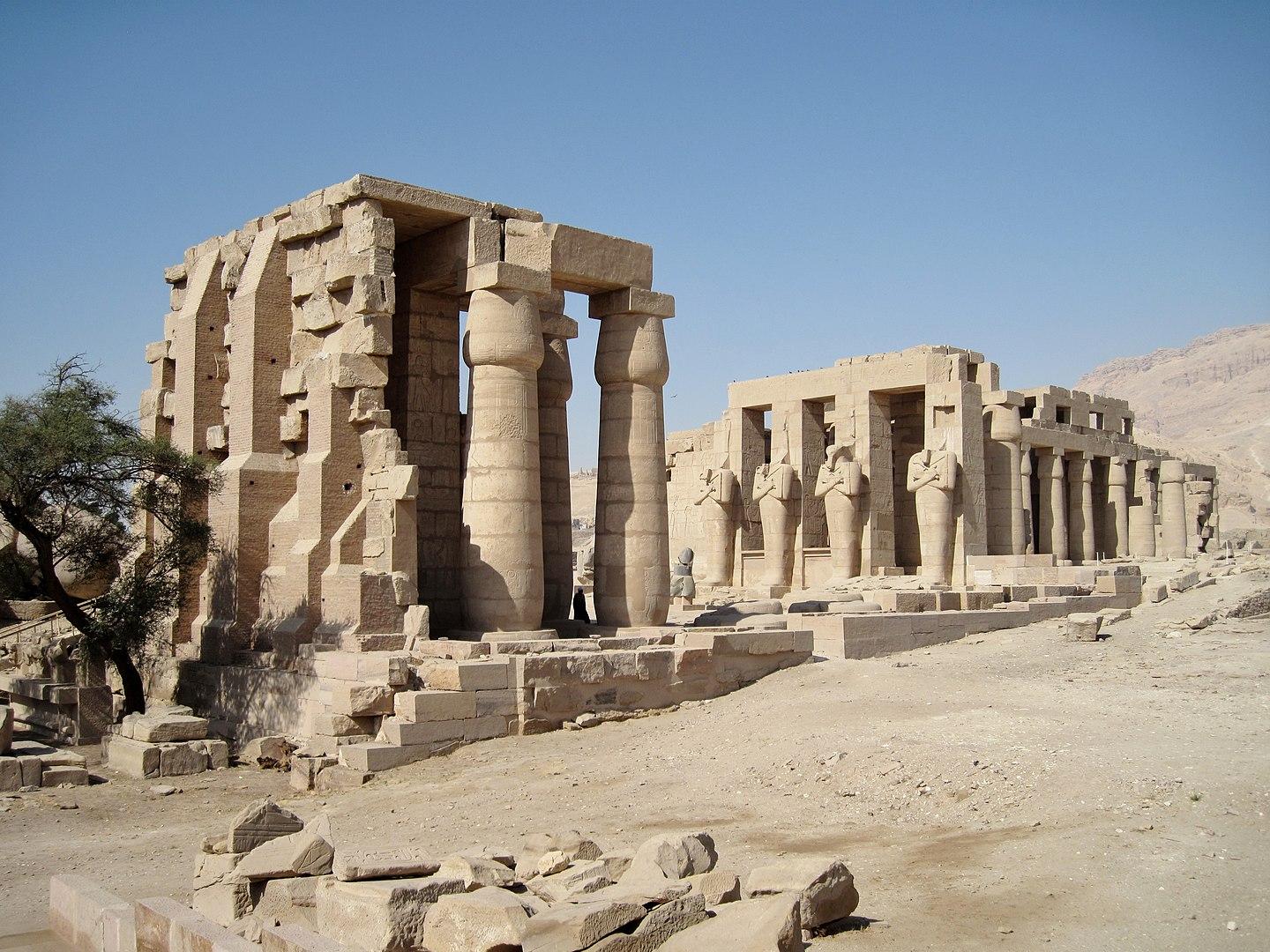
The first pylon, the massive gateway that once marked the temple's entrance, is largely collapsed, so most visitors start in the first court, walking straight into the site's history rather than reading it from a plaque. What's left standing gives a clear sense of scale even where the walls don't.
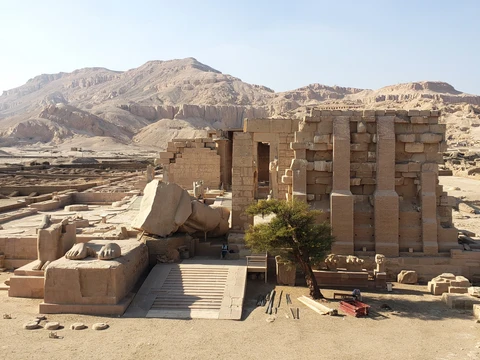
The second court is where the Ramesseum earns its reputation. Two rows of Osiride pillars line the court's sides. Each pillar depicts Ramses II in Osiris's form, arms crossed at the chest, a crook in one hand and a flail in the other, the two objects ancient Egyptians associated with royal authority. But the real draw is on the ground: the shattered colossus of Ramses II, originally standing about 17 to 18 meters tall and weighing an estimated 1,000 tonnes, now lies in pieces across the court. The head and torso are the most recognizable fragments, and this is the same statue that inspired Shelley's "Ozymandias."
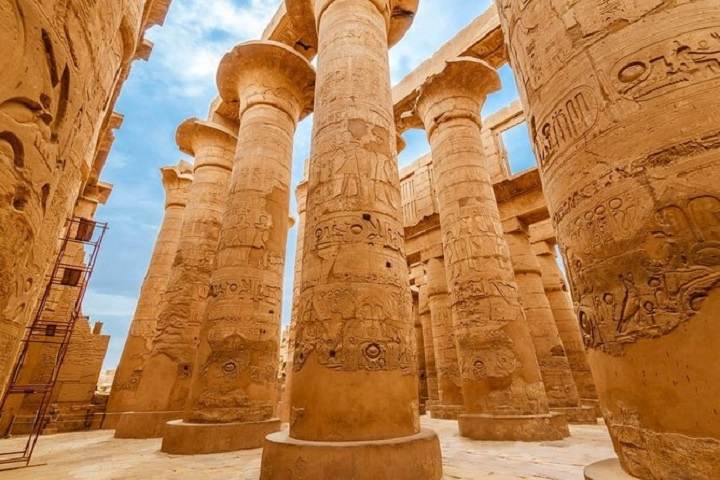
Beyond the second court, a hypostyle hall survives with columns still bearing traces of their original color, faded but visible if the light is right. The temple's astronomical ceiling, one of the earlier known depictions of a 12-month Egyptian calendar, is in the same area, though weathering has left parts of it hard to make out.
Reliefs of the Battle of Kadesh cover several of the temple's walls, showing chariot charges and the siege of the Hittite fortress. They're worth slowing down for, since they're some of the best-preserved battle scenes from Ramses II's reign anywhere in Luxor.
-Ramesseum Opening Hours and Time Needed
The Ramesseum is open daily. Hours run roughly 6 AM to 5 PM in winter and 6 AM to 6 PM in summer, though it's worth confirming locally since site hours can shift with the season or holidays.
Most visitors need about an hour at the site. That's enough time to walk both courts, see the fallen colossus up close, and get through the hypostyle hall without rushing. Coming right after opening or in the last two hours before closing helps avoid both the midday heat and the tour bus groups that tend to arrive mid-morning.
There's a rest house near the entrance with shade and a place to sit, useful given how exposed the site is otherwise. Comfortable shoes matter more here than at most Luxor temples, since the ground across the second court is uneven rubble rather than a paved path.
How to Get to the Ramesseum from Luxor
The Ramesseum sits on Luxor's West Bank, while most hotels and cruise docks are on the East Bank, so getting there means crossing the Nile first. The two common routes are a bridge crossing by road, roughly 7 kilometers south of central Luxor, or a short public ferry from near Luxor Temple, followed by a taxi or minibus on the other side.
Once on the West Bank, the Ramesseum sits inland from the river, close to Medinet Habu and the Colossi of Memnon. Independent travelers usually hire a taxi for the morning and cover several West Bank sites in one loop, since the temples are too spread out to walk between comfortably in the heat. A private day tour covering the Ramesseum alongside Medinet Habu and the Valley of the Kings is another option worth knowing about, and our Luxor Attractions page lists what pairs well with it.
Ramesseum vs. Medinet Habu: What's the Difference?
Both are mortuary temples on Luxor's West Bank, both belong to a Ramses, and that overlap trips up a lot of first-time visitors. The Ramesseum belongs to Ramses II, built in the 13th century BCE. Medinet Habu belongs to Ramses III, built roughly a century later, and it's the better-preserved of the two by a wide margin, with more intact walls, roofed sections, and color still visible on the reliefs.
The Ramesseum's main draw is the fallen colossus and the sense of scale that comes from seeing a monument this size in ruin. Medinet Habu's draw is closer to the opposite: it shows what a temple like this looked like closer to intact, including a fortified gate modeled on a Syrian fortress, something the Ramesseum doesn't have. Visitors short on time and choosing one over the other tend to pick Medinet Habu for architecture and the Ramesseum for atmosphere and history.
Neither replaces the other. They sit close enough together on the West Bank that visiting both in the same morning is a common and easy pairing.
-Best Time to Visit the Ramesseum
Winter, from November to February, is the most comfortable season, with daytime temperatures typically in the low-to-mid 20s°C, cool enough to walk around the open courts without rushing. Summer, especially June through August, pushes past 40°C by midday, and the Ramesseum has almost no shade beyond the rest house near the entrance.
Regardless of season, early morning right at opening or late afternoon in the last couple of hours before closing is the better window. The light is softer for photos of the fallen colossus, the heat is lower, and the tour groups that tend to cluster at the Ramesseum mid-morning haven't arrived yet or have already moved on.