El Alamein: The WWII Battlefield, War Cemeteries and Museum Near Alexandria
What Is El Alamein?
El Alamein is a small town on the Mediterranean coast, about 100 kilometers west of Alexandria. In the autumn of 1942 it became one of the most important places on Earth. Here, on the flat desert between the sea and the Qattara Depression, the British Eighth Army under Bernard Montgomery stopped the German advance under Erwin Rommel, the Desert Fox. Churchill later said that before Alamein we never had a victory, and after Alamein we never had a defeat.
The town today is mostly a resort area, but a short drive inland and along the coast sits a collection of memorials that draws visitors from Germany, Italy, Britain, Australia, New Zealand, and South Africa, the nations whose soldiers fought and died on this ground.
For travelers who know what happened here, it's one of the most moving days you can take from Alexandria. And for travelers who don't, it's the day they learn.
The Battle of El Alamein: Montgomery vs. Rommel
By mid-1942, Rommel's Afrika Korps had swept across North Africa and stood about 100 kilometers from Alexandria. Cairo was preparing for evacuation. Panic reached the banks and the embassies. If El Alamein fell, Egypt and the Suez Canal were next.
The geography did Britain one favor. The Qattara Depression to the south was impassable to tanks, which compressed the battlefield into a narrow corridor between the Depression and the sea. Rommel couldn't outflank anybody here. He would have to break through head-on, and Montgomery made sure he couldn't.
Montgomery arrived with a plan and overwhelming material: more than twice Rommel's tanks, three times his men, total control of the air. He also had something Rommel desperately lacked, fuel, because Allied submarines were sinking the tankers supplying the Axis from across the Mediterranean.
The battle opened on October 23, 1942, with a thousand guns firing in the dark. For twelve days the two armies ground against each other over mines and trenches. Rommel, sick and half his fuel gone, fought a defensive battle that impressed even his enemies. But by November 4, the line broke. The Afrika Korps began a retreat that would not end until Tunisia.
The battle cost both sides dearly, over 70,000 casualties between them. And it broke the myth of Rommel's invincibility while giving Britain its first major land victory of the war. Historians consider it the turning point of the whole North African campaign, and one of the pivotal battles of World War II.
The Commonwealth War Cemetery
The largest and most visited of the three sites sits a few kilometers west of the town, on the ground where the battle's final phase was fought. The Commonwealth War Cemetery holds 7,367 graves of British, Australian, New Zealand, South African, Indian, and other Allied soldiers. Many of them were barely out of their teens.
Everything here is kept perfect. The Commonwealth War Graves Commission maintains the lawns, the rows of headstones, and the plants the way it maintains its sites worldwide, and the result is a calm, geometric garden in the middle of the desert. In the rows you pass names from every corner of the British Empire, and a large number of stones that read only "A Soldier of the 1939-1945 War, Known unto God."
There's also a memorial wall for the more than 11,000 soldiers who died in the campaign but have no known grave, lost at sea or blown to nothing by shellfire.
Visitors from the Allied countries often come looking for specific names, grandfathers, great-uncles, and the Commission's staff can help locate individual graves. Even without a personal connection, most people leave quieter than they arrived.
The German Memorial: A Fortress on a Hill
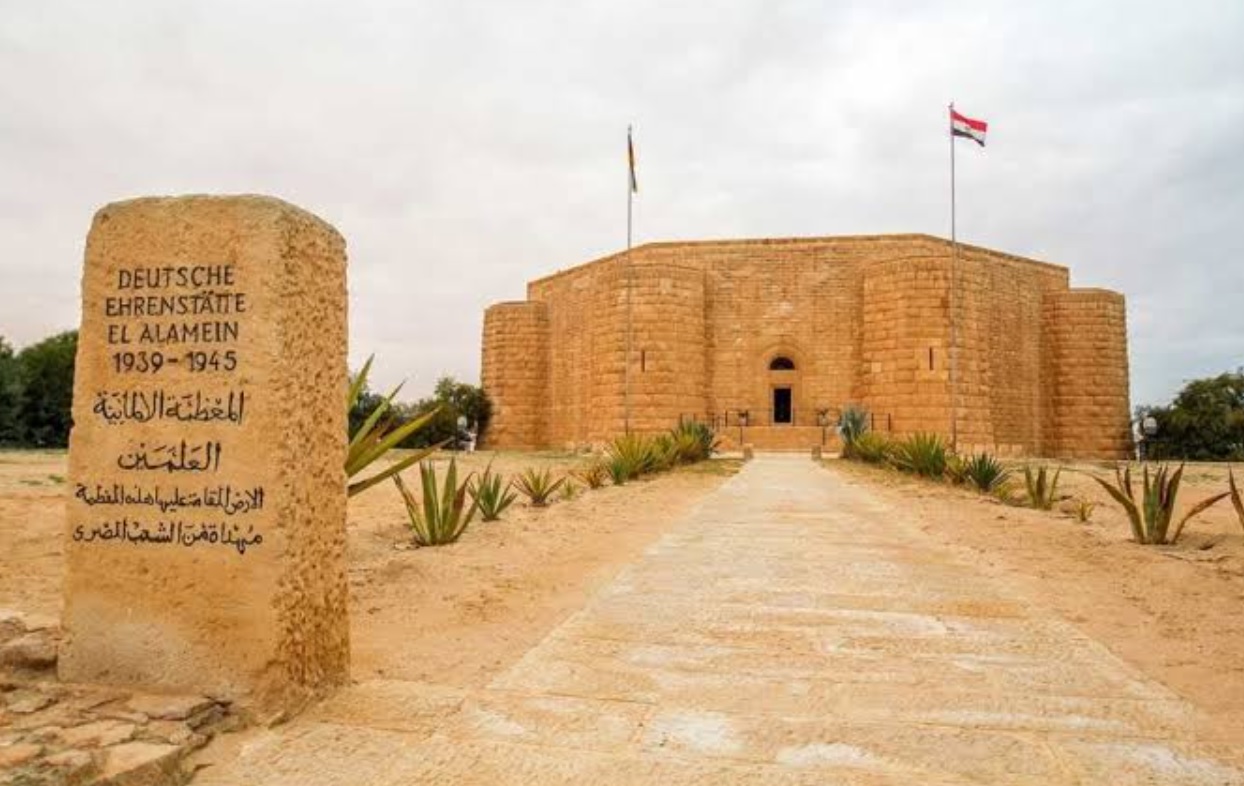
A few kilometers along the coast sits the German memorial, and it looks nothing like a cemetery. It's a fortress, a squat octagonal block of stone on a rise above the sea, built to resemble a medieval Italian castle, with the names of the German dead carved into its inner walls around a courtyard.
That was on purpose. This was built in the 1950s, after relations with Germany resumed, and rather than hide the fact that these were the enemy's dead, the memorial honors them as soldiers. Rommel himself visited Alexandria before the battle, and German veterans and families have been coming here for decades.
Inside, the walls carry thousands of names, and the structure's heavy, closed design gives it the feel of something between a fortress and a crypt. It's the most architecturally striking of the three sites.
The Italian Memorial: The Tower by the Sea
The Italian memorial sits closer to the coast road, and it's the most theatrical of the three. A tall white tower rises from a walled complex, and the design references ancient Rome: the entrance is flanked by two huge oars, carved in stone, marking the fallen of the Italian Navy as well as the army.
Around 4,800 Italian dead rest here, in a crypt below the tower, and the museum-like hall at the entrance displays mementos and photographs. Italy lost a huge number of men in the North African campaign, many of them to thirst and capture as much as combat, and the memorial carries that weight.
From the top of the tower, on a clear day, you can see the whole battlefield area spread out toward the horizon. It's the best view of what "flat desert" actually means, and why holding a narrow line here mattered so much.
El Alamein War Museum
Back near the town stands the El Alamein War Museum, opened in 1956 and renovated since. It's small but well done, and the battle becomes real here.
Inside, there are halls dedicated to each of the main combatants: the British, the Germans, the Italians, and the Egyptians, each displaying uniforms, weapons, maps, and personal items. The Egyptian hall matters because most visitors don't realize Egyptian soldiers and laborers were part of this campaign's logistics.
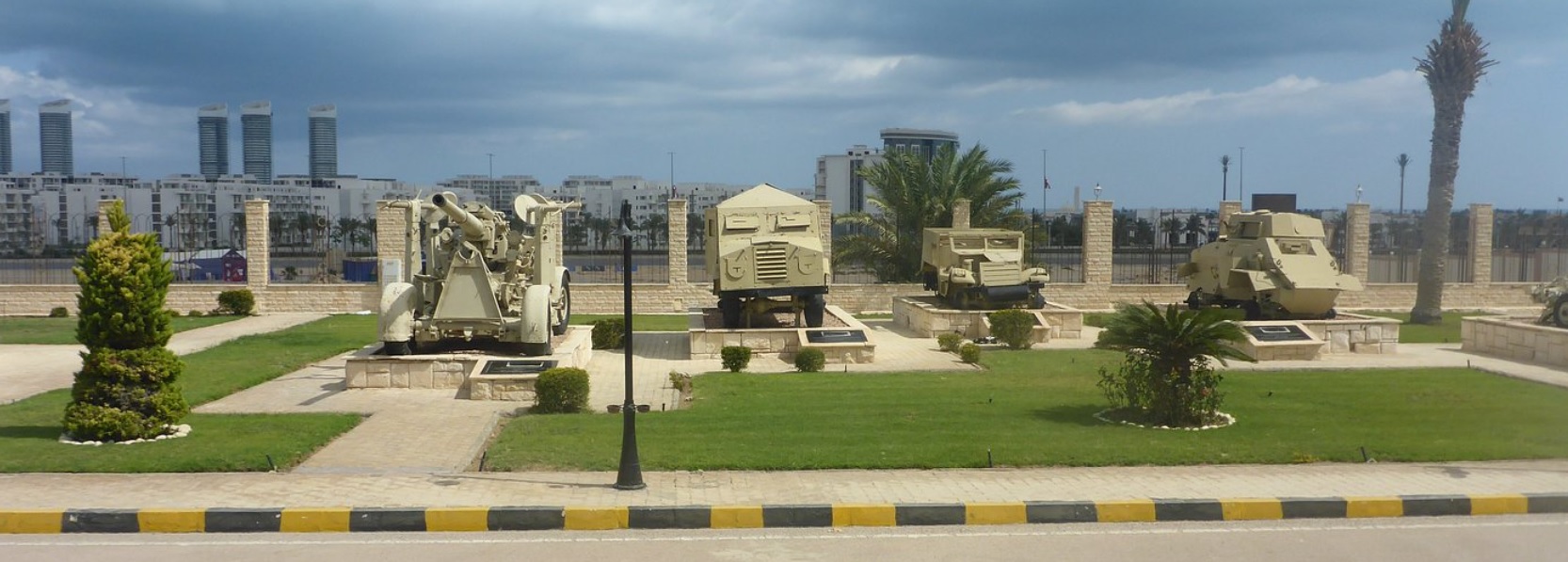
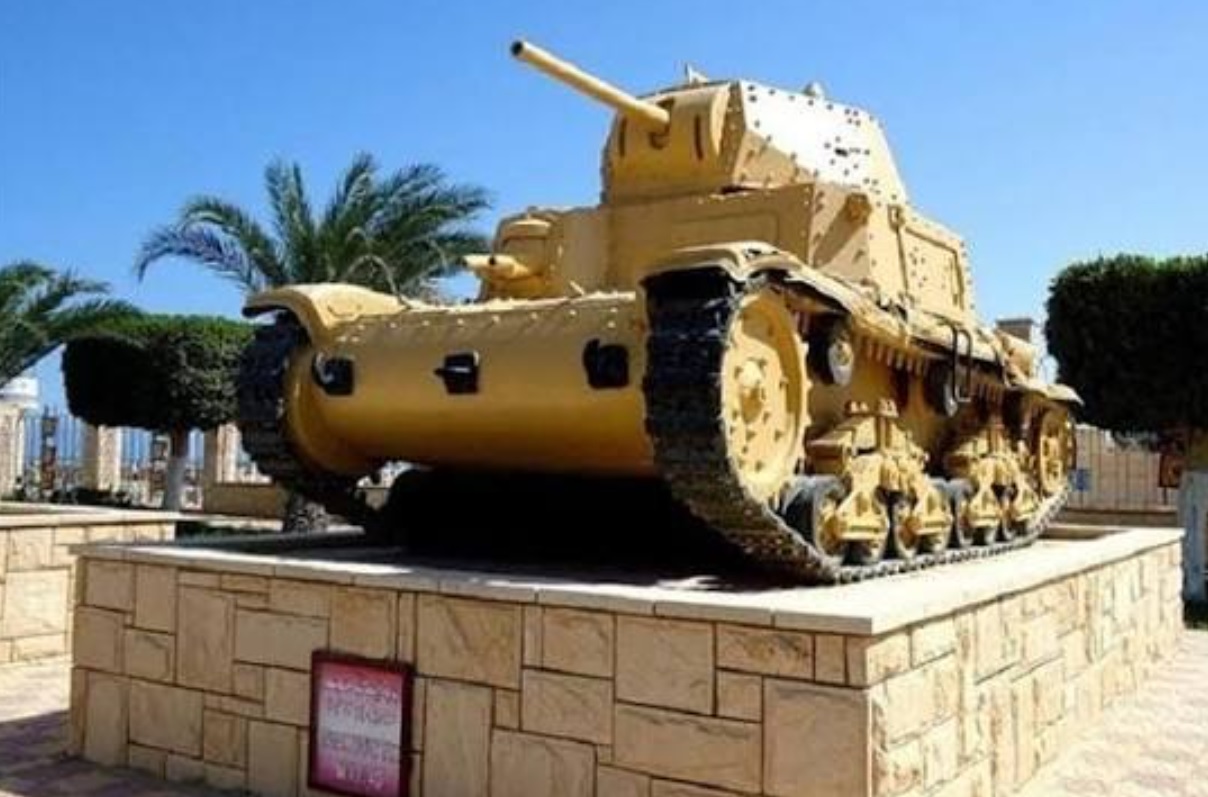
Outside, real tanks and artillery from both sides sit in the yard, including British and German armor. You can walk right up to them. The maps on the walls explain the battle's movements better than any text, and seeing the museum before the cemeteries makes the ground outside much easier to read.
Visiting El Alamein: Practicalities
El Alamein sits about 100 to 110 kilometers west of Alexandria, roughly an hour and a half by car on the desert road.
The Sites: The war museum, the Commonwealth cemetery, the German memorial, and the Italian memorial sit within a short drive of each other, connected by the coastal road. Seeing all four comfortably takes three to four hours.
Hours and Tickets: The museum has a small entry fee and keeps daytime hours. The cemeteries and memorials are free and generally open through the day.
How Long: The whole circuit fits in a day trip from Alexandria easily. Add Taposiris Magna, which sits on the same road closer to the city, and you've built a full western-coast day.
Getting There: A hired car or a tour is the practical route. Public transport exists but doesn't serve the individual sites, which are spread along the coast road.
Is It Worth the Trip?
If World War II history means anything to you, this is not a maybe, it's essential, and it's the only place in Egypt where the war left this kind of mark. The combination of the battle story, the three memorials with their different national characters, and the museum is a complete, moving day.
If WWII isn't your thing, the honest answer is that it's a long drive for gravestones, and you'd be better served in the city.
Four sites spread along a coast road, an hour and a half from the city, and a story that doesn't work unless someone tells it properly. Aten Tours can arrange the western-coast day, El Alamein's battlefield, cemeteries, and museum, with Taposiris Magna or Abu Mena folded into the route, so you get the history from a guide who knows it instead of reading your phone at every gate.