The Greco-Roman Museum of Alexandria: Reopened After 18 Years, and What's Inside
What Is the Greco-Roman Museum?
The Greco-Roman Museum in Alexandria is dedicated entirely to Egypt's Greek and Roman period, roughly from Alexander the Great's arrival in 331 BC through the Roman era and up to the Muslim conquest in 641 AD. It sits in a neoclassical building on Gamal Abdul Nasser Road, near El Raml train station, and the facade still carries the Greek inscription "MOYΣEION," a reference to the mouseion of ancient Alexandria, the old gathering place for scholars that once stood nearby.
It was the first museum anywhere built specifically around this slice of Egyptian history. Cairo's Egyptian Museum focuses on pharaonic Egypt, and European classical museums cover Greek and Roman art more broadly, but neither one does what this place does.
The 18-Year Closure (and Why It Took So Long)
The museum closed in 2005 for what was meant to be a renovation, and it didn't reopen for eighteen years. The work included structural reinforcement, a new upper floor, redesigned interiors, and modern lighting and climate control, the kind of overhaul a 19th-century building genuinely needed, though it dragged on far longer than anyone expected going in.
It reopened in October 2023, with Egypt's Prime Minister Mostafa Madbouly leading the ceremony alongside the Minister of Tourism and Antiquities. Visitors who'd heard about the museum for years walked in that fall to find something almost entirely rebuilt on the inside.
History: From a Rented House to a National Landmark
The idea started with Giuseppe Botti, an Italian scholar who arrived in Alexandria in 1889 and watched the city's construction boom tear through layers of buried history with barely a second thought. He pushed for a dedicated institution to collect and protect what was left before it disappeared entirely.
That effort paid off in 1892, when Khedive Abbas Helmy II inaugurated the museum in a modest rented house. It didn't stay small for long. Within two years, a permanent home was already underway: a neoclassical structure whose foundation stone was laid by the statesman Nubar Pasha, with architects Dietrich and Stenon handling the design. The whole building went up in roughly twelve months, and by 1895 the collection had a permanent address in the Al Attarin district it would keep for over a century.
Botti ran the museum until 1904, when Italian archaeologist Evaristo Breccia took over and led it for nearly three decades. Achille Adriani followed him, continuing a run of directors who shaped what the collection became long after its founder had moved on.
The Underwater Connection
Not everything in this museum came from digging in the ground. A section of the collection was pulled out of the sea, recovered by underwater archaeologist Franck Goddio's team from Thonis-Heracleion and Canopus, two ancient port cities that sank off Alexandria's coast and stayed lost for well over a thousand years until divers found them again in 2000.
One piece makes the point better than any description could. Divers pulled a carved stone stele out of the seabed at Thonis-Heracleion, and it now shares a room with an almost identical slab that surfaced on land at Naukratis all the way back in 1899. Both carry the same ancient royal decree, found more than a century apart in completely different ways, and now share the same room.
What's Inside — The Highlights
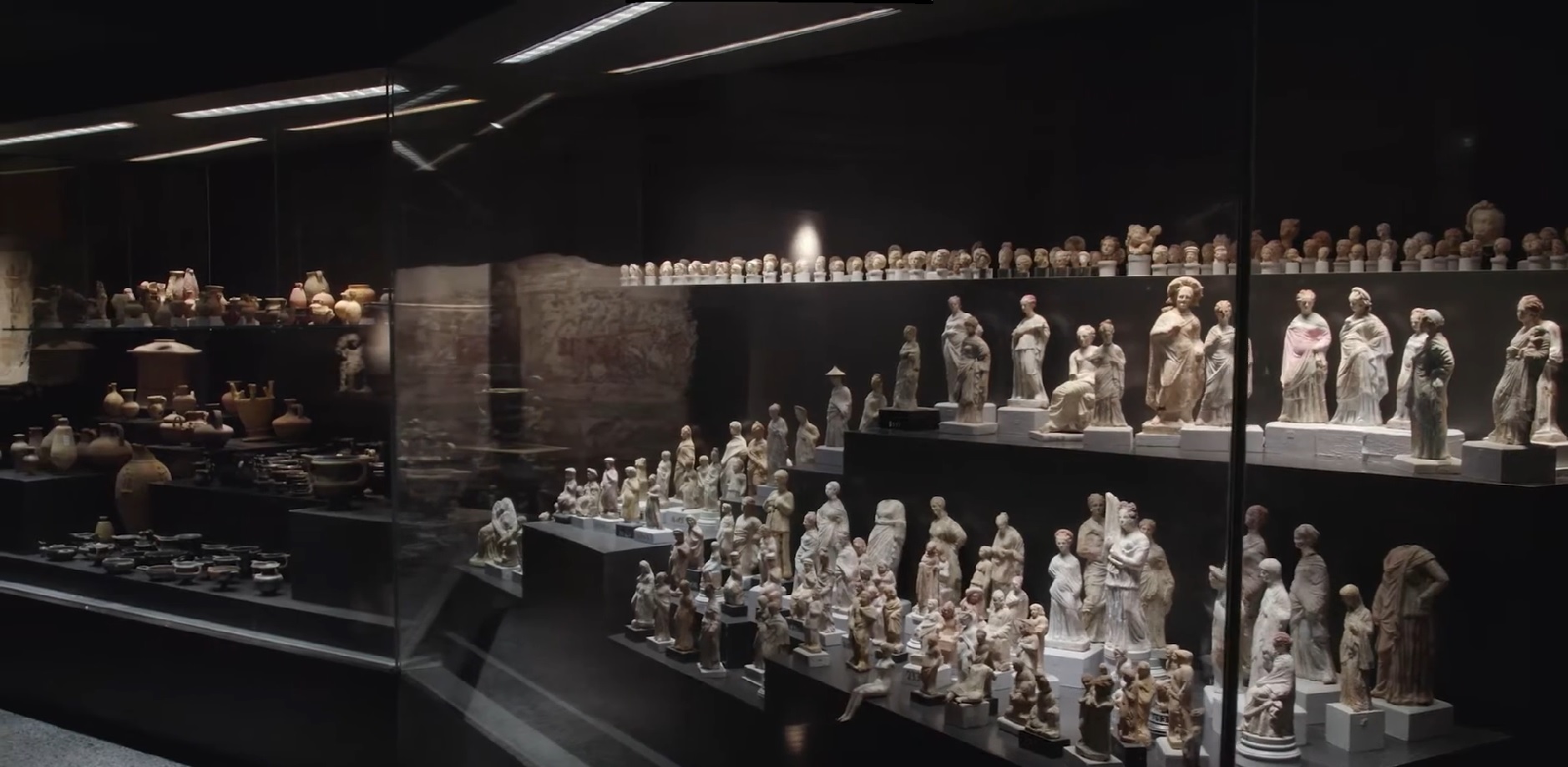
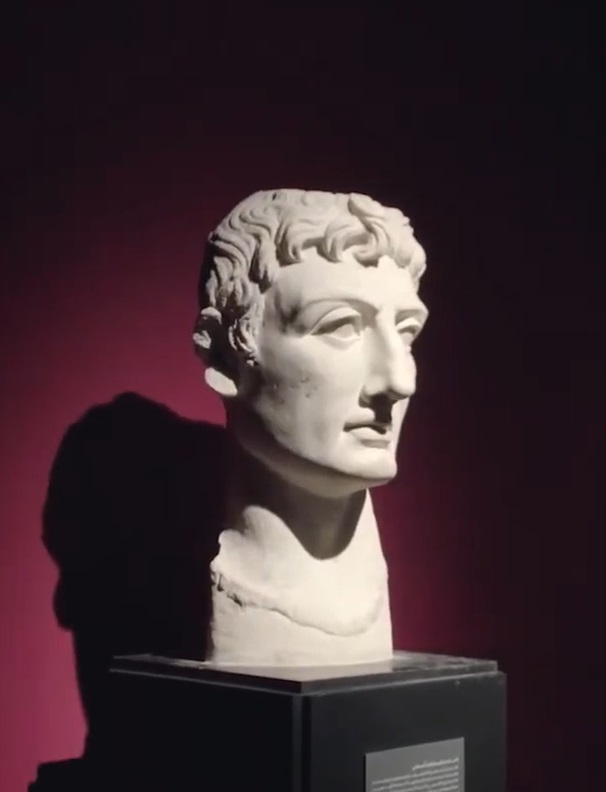
The ground floor holds 27 exhibition halls arranged in roughly chronological order, from the 5th century BC through the Byzantine and Coptic era. Four more specialized rooms sit on the upper level, a museum education hall, an archive and registration hall, a gypsoteca for plaster casts, and a study and research hall, which is why some sources round the total up to 30 or 31 depending on whether they're counting public galleries or every room in the building. Either way, there's a lot to see. A handful of pieces stand out from the rest. The Serapis Head, carved in fine white marble, was found near Pompey's Pillar, the same column covered in Aten Tours' earlier piece on its Diocletian dedication. It depicts Serapis, a god the Ptolemies created by blending Osiris and Apis.
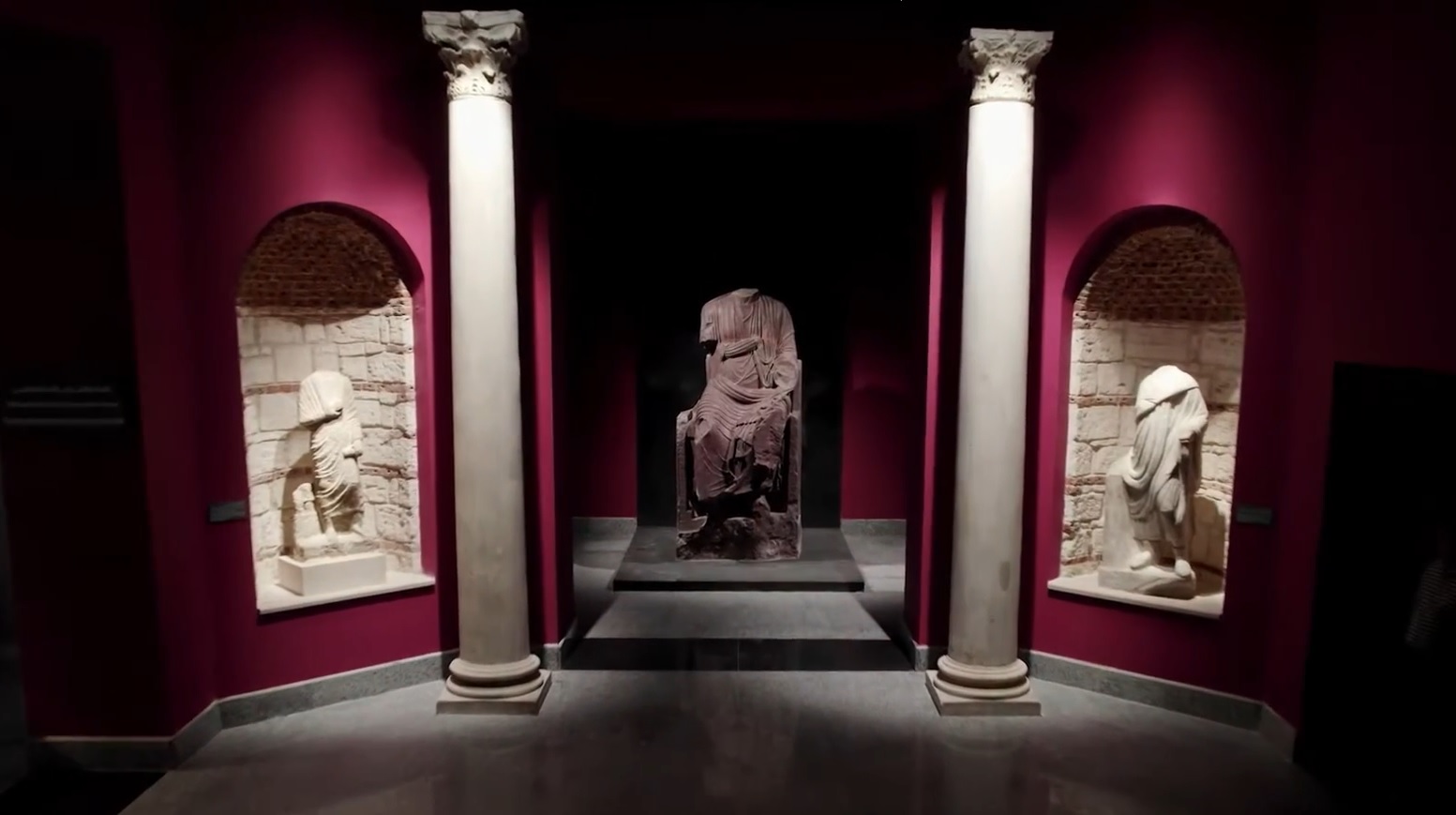
The Marcus Aurelius statue, a large white marble figure from the 2nd century AD, was unearthed beneath the Sayed Darwish Theater, not far from the Kom El Dikka Roman Theatre site. Beyond that, there's a well-known Medusa mosaic, Fayum mummy portraits painted in wax on wood panels, a room devoted to mummies and sarcophagi, and a bronze head of Emperor Hadrian with eyes inlaid in ivory and glass.
A few other pieces are worth hunting down too. A black basalt statue of the Apis Bull, set up during Hadrian's reign, turned up west of Pompey's Pillar, and a colossal red granite head of Ptolemy IV, recovered from Abuqir, still wears Egypt's double crown. One of the more striking sarcophagi shows Ariadne asleep on Naxos, with the god of sleep standing watch over her and her husband Dionysus approaching in a procession carved along the rest of the panel.
How Many Artifacts, Really?
Sources used to disagree sharply on this, with figures ranging from around 10,000 up to more than 40,000. Egypt's Ministry of Tourism and Antiquities has since put a number on it: roughly 40,000 objects in the total collection, spanning the Greek, Roman, and Byzantine periods, with somewhere between 6,000 and 20,000 of those actually out on display across the renovated halls.
That's still a fairly wide display range, which suggests exhibit rotations happen fairly often, or that different counts are being taken at different points in the ongoing setup after the reopening. Either way, the bulk of the collection, tens of thousands of pieces, stays in storage and archives rather than on public view at any given time.
Visiting Practicalities
The museum runs 9:00 AM to 5:00 PM Sunday through Thursday, with the ticket window closing roughly half an hour before. Friday and Saturday stay open later, until 7:00 PM, so it's worth planning around that if you want an evening visit on either of those two days. Foreign adults pay 400 EGP, foreign students pay 200 EGP, and Egyptian visitors pay considerably less: 40 EGP for adults, 20 EGP for students. Egyptian seniors over 60, Egyptians with disabilities, and orphaned children get in free. Mobile phone photography is free too, as long as you skip the flash.
Most people get through the highlights in about 45 minutes. Anyone wanting a fuller look at the whole collection should set aside closer to 90 minutes or two hours instead.
What's Nearby
The museum sits close to El Raml station in central Alexandria, within walking distance of several downtown sites. The Roman Theatre at Kom El Dikka is a short walk away, and both Pompey's Pillar and the Royal Jewelry Museum are a short taxi ride from here.
Given how central it is, most people fold it into a stop alongside one or two other downtown sites rather than treating it as a trip on its own.
Is It Worth Visiting?
For anyone interested in ancient history, yes. This is one of the best museums in Egypt outside Cairo, and the recent renovation means the displays and lighting hold up well by regional standards. The Serapis Head and the Marcus Aurelius statue both tie directly back to other Alexandria sites, so a visit here fills in gaps that standing at those sites alone won't.
It's not overwhelming in size, which works in its favor. You can see the highlights in under an hour and still leave having learned something real about the city's Greco-Roman past.
Most people visit as part of a broader day exploring central Alexandria. Aten Tours' Alexandria day tours can include a stop here alongside nearby sites like Pompey's Pillar and the Roman Theatre, with a guide who can connect what's in the museum's cases to what's still standing elsewhere in the city.