Alexandria's Greek and Roman Heritage: What's Still Standing and How to See It
Alexandria was once the most important city in the eastern Mediterranean. Founded by Alexander the Great, developed by the Ptolemies, and absorbed into the Roman Empire, it was a place where Greek philosophy met Egyptian religion, where Roman engineering met African trade routes. The Great Library. The Lighthouse — one of the Seven Wonders of the Ancient World. The Temple of Serapis. All of it is gone now, at least in its original form. Earthquakes in the 14th century, rising sea levels, and centuries of urban construction on top of the ruins destroyed most of what stood.
What survives is fragmentary. A column here, an underground tomb there, a mosaic floor in a Roman villa. But these fragments are still striking — and seeing them in person, in the city where they were built, hits differently than seeing them in a museum hall thousands of kilometres away. This guide covers the sites you can actually visit, plus a few you can't (but should know about).
The Sites You Can Visit
Catacombs of Kom el Shoqafa
This is the single most impressive Greco-Roman site in Alexandria, and it's not close. Discovered by accident in 1900 when a donkey fell through a hole in the ground (that's the story anyway), the catacombs are a multi-level underground burial complex carved into the rock, dating back to the 2nd century AD.
What makes them unusual is the visual mashup. You descend a spiral staircase past Egyptian-style statues with Roman clothing and Greek architectural details. The main burial chamber has a fusion of Egyptian, Greek, and Roman funerary art that you won't find anywhere else — Anubis dressed in a Roman military uniform, for example. The three levels go deep, though the lowest level is usually flooded and not accessible.
Practical notes: it's in the Karmouz district, west of the city centre. You climb down a circular staircase — not ideal if you have mobility issues. It can get humid underground. Allow 45 minutes to an hour. If you're combining it with Pompey's Pillar (and you should — they're a short walk apart), plan for half a day in this part of the city.
Pompey's Pillar and the Serapeum
Pompey's Pillar is the tallest ancient monument still standing in Alexandria — a single red granite column rising about 26 metres, made from Aswan granite. The name is wrong. It has nothing to do with Pompey. It was actually erected around 300 AD in honour of the Roman Emperor Diocletian. But the misnomer stuck, and at this point it's not going anywhere.
The column is impressive on its own, but the real story is what it stands on: the remains of the Serapeum, once the grandest temple in Alexandria. The Serapeum was dedicated to Serapis, a hybrid god created by the Ptolemies to bridge Greek and Egyptian religion. The temple complex once included libraries, lecture halls, and shrines — it was essentially a religious and intellectual campus. Today, what's left is the platform, some underground passages (the "cisterns"), scattered stone fragments, and the pillar itself.
The site is on a hill, and on a clear day you can see the sea from the top. It's a five-minute walk from the catacombs. The two sites together form the core of any Greco-Roman day in Alexandria.
Roman Theatre and Kom el Dikka
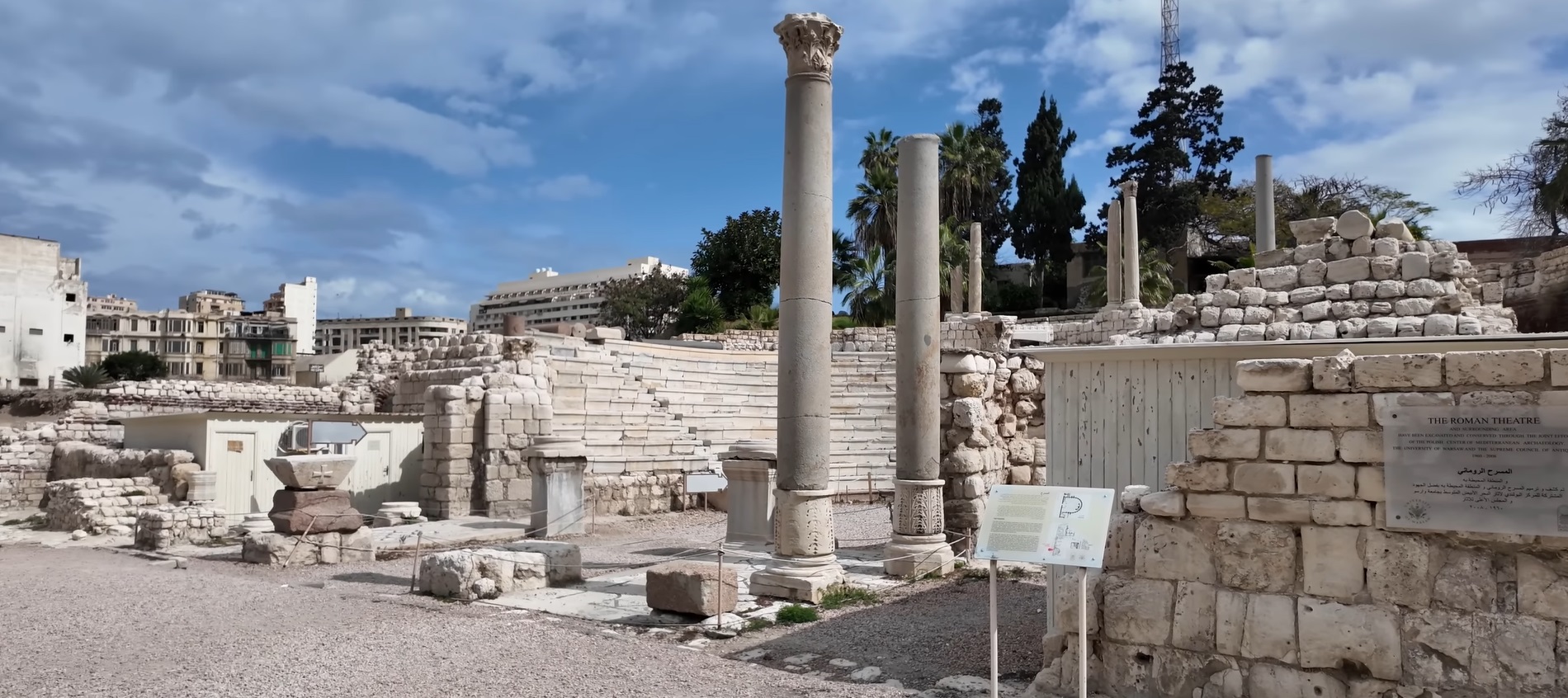
In the middle of the city, there's an archaeological zone called Kom el Dikka. The star attraction is a small Roman theatre — not a massive amphitheatre, but a compact performance space with marble seating rows that could hold about 600-800 people. It was likely used for concerts and poetry readings rather than gladiatorial combat.
But Kom el Dikka is more than the theatre. The site includes the remains of Roman baths, a residential quarter with several villas, and most notably the "Villa of the Birds" — a Roman house with remarkably well-preserved floor mosaics depicting birds. There are also lecture halls (auditoria) that some scholars believe were part of an ancient educational institution, possibly connected to the intellectual tradition of the Library of Alexandria.
Kom el Dikka is in the city centre, easy to reach, and makes a good pairing with the Graeco-Roman Museum (see below). Allow an hour or so.
The Graeco-Roman Museum
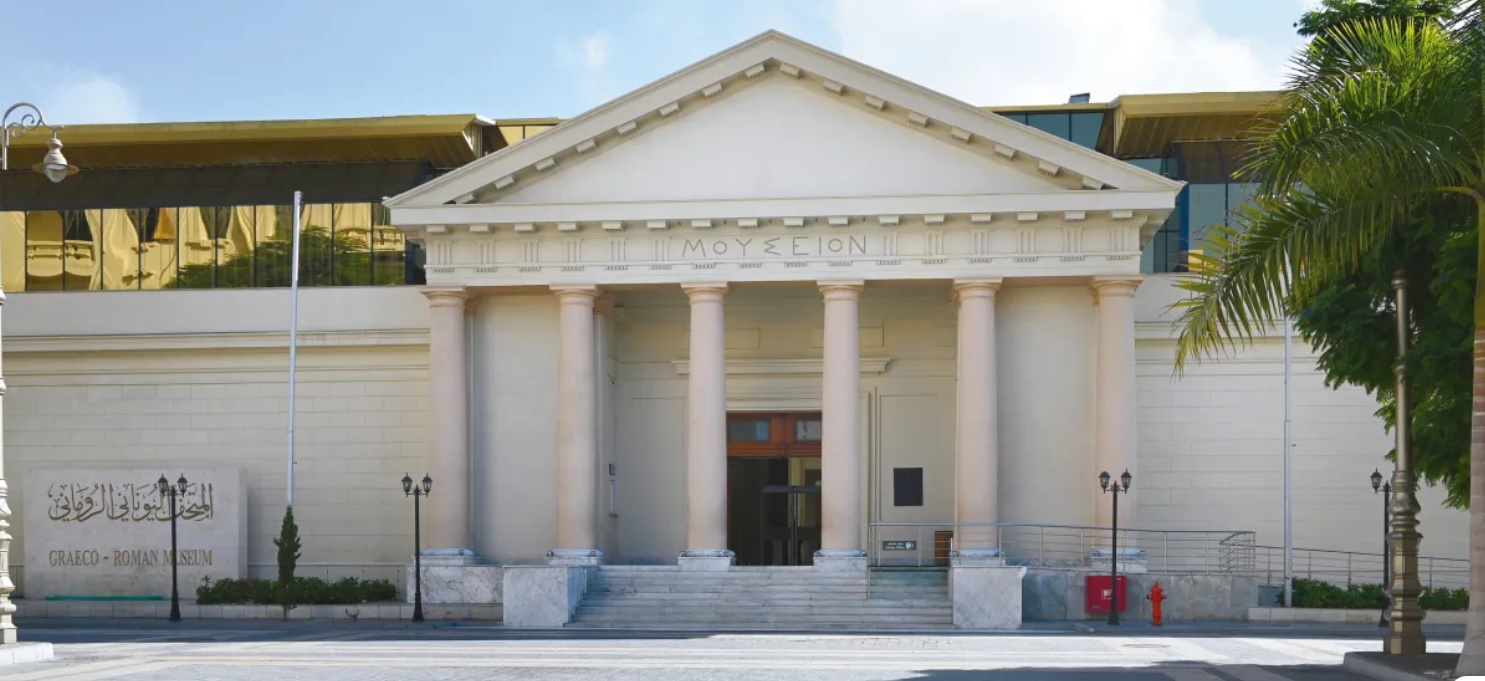
This museum reopened to the public after an extensive renovation that lasted nearly two decades. It's the only museum in Egypt dedicated entirely to the Greek and Roman periods, and its collection of over 40,000 objects covers sculpture, mosaics, coins, pottery, and everyday objects from centuries of Greco-Roman life in Alexandria.
If you want context for everything you've seen at the outdoor sites, this is where you get it. The displays cover the Ptolemaic period through the Roman era and into early Byzantine times. Statues of Greek gods, Roman emperors, and Egyptian deities side by side — which is essentially the story of Alexandria in microcosm.
The museum is on Al-Mathaf Street ("Museum Street") in the city centre. It's open daily. Allow 1-2 hours depending on how much you like reading museum labels.
Alexandria National Museum
This is a broader museum covering Pharaonic, Greco-Roman, Coptic, and Islamic periods. If you only have time for one museum, this one gives you the full sweep of Alexandria's history rather than just the Greco-Roman chapter. The Greco-Roman section is strong, with a good collection of sculpture and artifacts from the Ptolemaic and Roman periods. It's housed in a former palace on the Corniche, which is a nice setting.
If you're focused specifically on Greek and Roman heritage, the Graeco-Roman Museum is the better choice. If you want the big picture, come here.
The Sites You Can't Visit (But Should Know About)
Part of understanding Alexandria's Greco-Roman heritage is accepting that the most important things are no longer there. The city was built on a coastline that has shifted over the centuries — parts of the ancient city are now underwater, and parts are under modern buildings. Two sites are worth mentioning even though you can't walk through them:
The Great Library of Alexandria. Once the largest library in the ancient world, holding hundreds of thousands of scrolls. It was destroyed gradually over centuries — not in a single dramatic fire, despite what popular accounts suggest. Nothing of the original library survives. The modern Bibliotheca Alexandrina, while architecturally striking, is a new building with no direct physical connection to the ancient one. For more on visiting the modern library, see our guide to things to do in Alexandria.
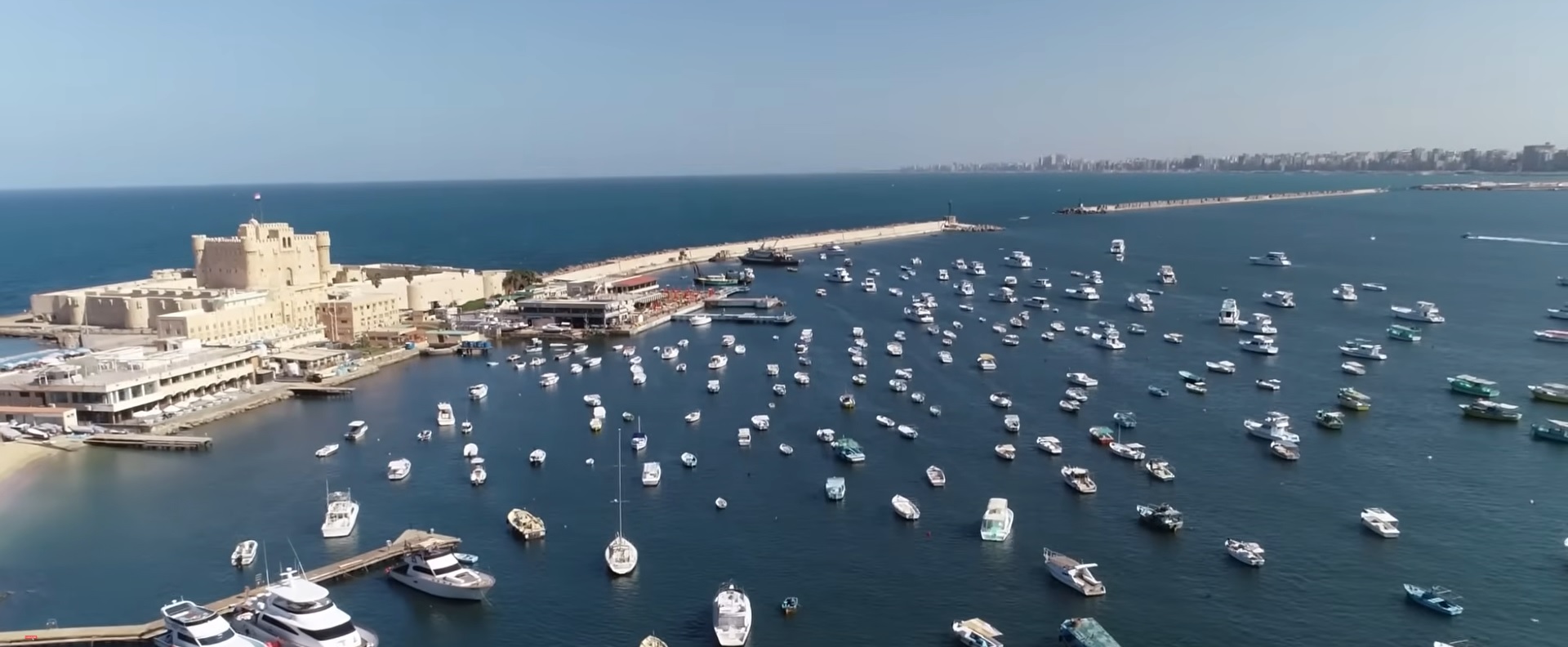
The Pharos Lighthouse. One of the Seven Wonders of the Ancient World, the lighthouse stood on the eastern tip of Pharos Island (where the Qaitbay Citadel now stands). It was toppled by earthquakes in the 14th century. Some of its stone blocks were reportedly incorporated into the citadel's walls. The Citadel of Qaitbay is worth visiting on its own — see our dedicated guide for details.
What's Underwater
A significant portion of ancient Alexandria lies at the bottom of the harbour. French archaeologist Franck Goddio and his team have been exploring the eastern harbour since the 1990s, uncovering columns, sphinxes, statues, and what are believed to be the remains of Cleopatra's palace and the royal quarter. Some of these finds are displayed at the Graeco-Roman Museum. If you're a diver, there are occasional organised dives to the underwater sites. For non-divers, the museum displays and the documentary footage are the closest you'll get.
Planning a Greco-Roman Day in Alexandria
The sites cluster geographically, which makes planning straightforward.
Western cluster (half a day): Catacombs of Kom el Shoqafa and Pompey's Pillar/Serapeum. These two are within walking distance of each other in the Karmouz district. Add the Graeco-Roman Museum if you have time (it's back towards the centre).
Central cluster (half a day): Kom el Dikka (Roman theatre and Villa of the Birds) plus the Graeco-Roman Museum. These are both in the city centre and close to each other.
Doing both clusters in one day is possible but it's a lot. You'd want to start early, have lunch somewhere in between, and be realistic about museum fatigue.
Practical Tips
- Tickets: Each site has a separate entrance fee. Prices are modest — typically EGP 50 to 150 per site, though this varies and may change. Check current prices before you go.
- Guides: The catacombs and Kom el Dikka benefit enormously from a guide. The signage exists but doesn't always tell the full story. If you're interested in the history rather than just the aesthetics, budget for a guide at least at the catacombs.
- Timing: The outdoor sites (Pompey's Pillar, Kom el Dikka) are better in the morning before it gets too hot. The catacombs are underground so temperature doesn't matter much. The museums are air-conditioned.
- What to wear: Comfortable shoes. The catacombs involve stairs and uneven surfaces. Kom el Dikka has open-air paths.
- Photography: Photography is generally allowed at the outdoor sites. Museum photography policies vary — check before you start shooting.
- Combining with other activities: These sites pair well with a walk through the old quarters of Alexandria. After seeing the Roman remains, you can explore the surrounding neighbourhoods, grab coffee at a historic café, or walk along the Corniche. For café recommendations, see our guide to the best cafés in Alexandria. For evening plans, see Alexandria at night.
For broader trip planning, see our guides on where to stay in Alexandria and the best time to visit Alexandria. If you're coming from Cairo, check how to get from Cairo to Alexandria.