Stanley Bridge in Alexandria: The Real Story Behind Egypt's First Sea Bridge
What Is Stanley Bridge?
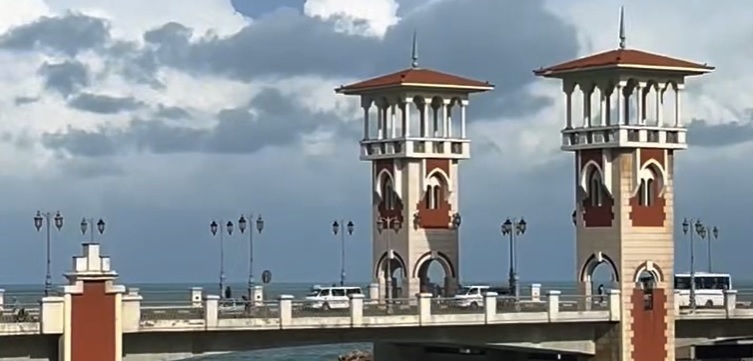
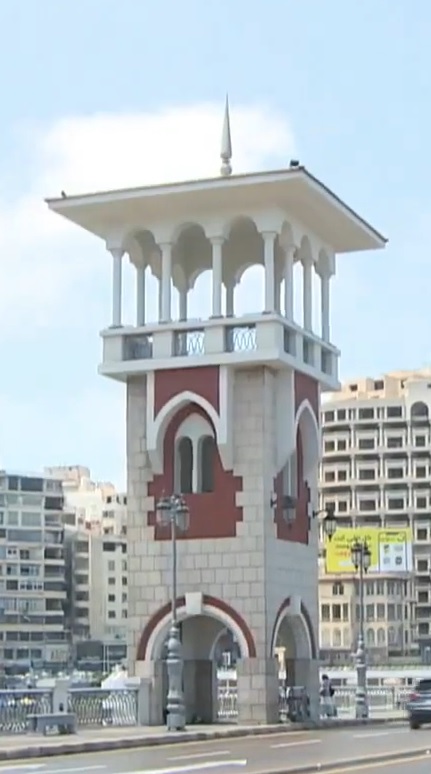
Stanley Bridge is a 400-meter concrete bridge stretching across Stanley Bay on Alexandria's Corniche, opened in 2001 as the first bridge in Egypt built directly over the sea. It replaced a narrow coastal road that had become badly congested as the city grew, carrying traffic in a wide arc over the bay instead of squeezing it along the shore. Four neo-Islamic towers mark its ends, styled to echo the nearby Montaza Palace — they don't hold anything up structurally, they're just there to look right against the skyline.
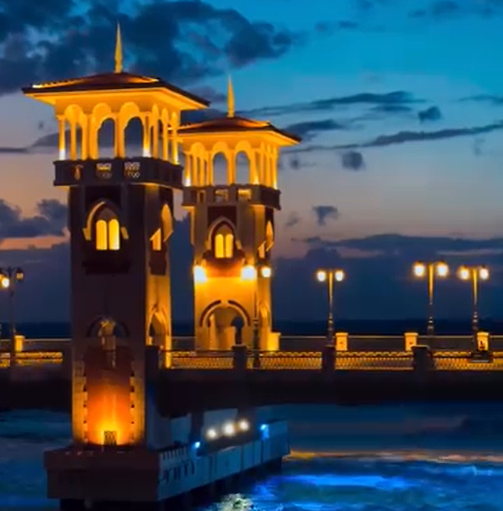
Right below it, Stanley Beach draws its own crowd, one of the busier stretches of sand in the city, and locals tend to know the bridge better as a backdrop for evening walks than as a piece of traffic infrastructure. It photographs best around sunset, when the towers pick up some color instead of sitting flat against the sky.
Why Is It Called "Stanley" Bridge?
One travel site claims the bridge dates to 1937 and was named after a British baron, Lee Plunket, who served as Governor-General of Sudan. None of that checks out — wrong decade, wrong country connection, and no other source mentions this person in relation to the bridge at all. It looks like a factual error that got copied around a few low-quality listings.
The real explanation is simpler. The bridge takes its name from Stanley Bay, the neighborhood and beach beneath it, and the bay itself is named after Henry Morton Stanley, the British-American explorer who traced the source of the Nile to Lake Victoria in 1875. Stanley had nothing to do with Alexandria personally — his name just got attached to a fashionable neighborhood decades ago, and the bridge inherited it when it went up over a century later.
How and Why It Was Built
By the 1990s, Alexandria's Corniche had a problem. The coastal road ran along a strip that had grown too narrow for the traffic using it, and widening it inland would have meant tearing into the private beachfront properties lining the bay. So engineers went the other way: instead of a road around the water, they built one over it.
Arab Contractors, one of Egypt's largest construction firms, took on the build during Hosni Mubarak's presidency. Estimates for the total cost land around 30 million Egyptian pounds, though exact figures from a project this old aren't easy to pin down with certainty. It opened to the public on September 2, 2001, becoming the first bridge in Egypt built directly over open sea.
Architecture and Design
Structurally, the bridge is built as a continuous pre-stressed concrete box girder, split into six spans that together make up its 400-meter length. Engineers varied the depth of the structure along each span — thinner in the middle, thickest where it lands on the support piers — a common trick for keeping a long span rigid without adding unnecessary weight. Those piers themselves go deep, anchored into the seabed on wide concrete piles built to handle both the load and the constant push of the sea.
What people actually notice isn't any of that engineering, though. It's the towers at either end, built in a neo-Islamic style that borrows directly from the nearby Montaza Palace: pointed arches, warm stonework, ornamentation that has nothing to do with holding the bridge up. They're decoration, plain and simple, added so the crossing would look like it belonged to Alexandria instead of just being a road over water.
Best Time to Visit and Photography Tips
Go at sunrise or sunset if you can. Mornings tend to be quiet, with local fishermen working the rocks below and soft light on the water. Sunset draws more people, when the sky over the Mediterranean shifts through orange and pink before the evening lighting comes on.
After dark, the towers light up gold against the night sky. There's no entry fee and no set hours here — it's a public road and walkway, open around the clock — so the only real scheduling decision is which light you want to catch.
What's Nearby
Stanley Beach sits directly beneath the bridge, one of the more popular stretches of sand in the city, with cafés and casual seafood spots along the promenade above it.
Further along the Corniche, Montaza Palace and its gardens are within reach for anyone continuing east, while Qaitbay Citadel sits toward the other end of the coastal road, built on the site once occupied by the ancient Lighthouse of Alexandria. The Catacombs of Kom El Shoqafa and Bibliotheca Alexandrina fall along the same general stretch of the city, so it's easy to fold Stanley Bridge into a broader day along the Corniche rather than treating it as a stop on its own.
Is It Worth Visiting?
On its own, Stanley Bridge won't take more than twenty or thirty minutes. There's no ticket, no museum, nothing to tour inside — you walk across it or photograph it from the beach below.
What makes it worth the stop is context. It's less than thirty years old, has no ancient history behind it, and yet it's become one of the most recognizable images of modern Alexandria anyway. That's a different kind of landmark than the Roman columns and Ptolemaic ruins elsewhere in the city. If you're already walking the Corniche between Qaitbay Citadel and Montaza Palace, it costs nothing extra to stop and see why locals treat it as one of the city's defining sights.
Most visitors see Stanley Bridge as one stop among several along the Corniche rather than a destination on its own. Aten Tours' private Alexandria day tour covers this stretch of the coastline alongside Qaitbay Citadel and Montaza Palace, with a guide who can point out details like the bridge's towers and their connection to the palace nearby — the kind of context that's easy to miss walking past on your own.