Bab al-Futuh: The Fatimid Gate That Guarded Cairo for Nearly 1,000 Years
What Is Bab al-Futuh?
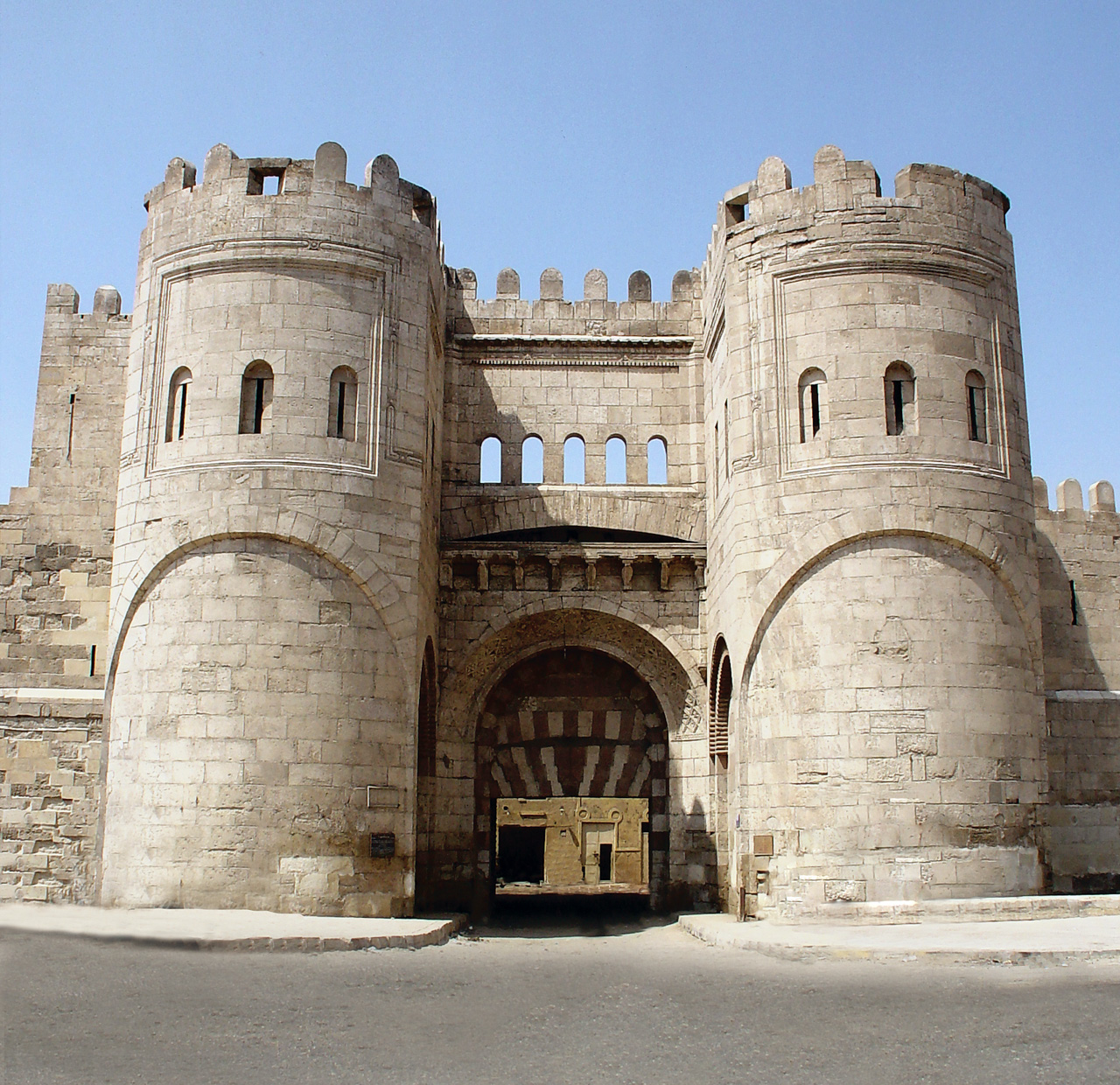
Bab al-Futuh is one of three surviving gates in the Fatimid-era walls that once enclosed medieval Cairo, standing at the northern edge of what is now known as Islamic Cairo. Completed in 1087 AD, the gate measures roughly 22 meters tall and 23 meters wide, with two massive rounded towers flanking a recessed stone archway. It sits at the northern end of Al-Muizz Street, directly across from its twin gate, Bab al-Nasr, and forms part of the same defensive line that once included Bab Zuwayla to the south.
The name translates to "Gate of Conquests." Before its reconstruction in stone, an earlier gate on roughly the same site was called Bab al-Iqbal, or "Gate of Prosperity." When the vizier Badr al-Jamali rebuilt Cairo's walls in the late 11th century, the gate was given its present name and became one of the main points where processions, including returning pilgrims and military campaigns, entered the walled city.
Unlike many structures from the same period, Bab al-Futuh is still standing largely as it was built: visitors today can walk through the original archway, see the stone construction up close, and continue north along Al-Muizz Street exactly as medieval travelers once did.
History: Why Badr al-Jamali Rebuilt Cairo's Walls in Stone
When Cairo was first founded in 969 AD by the Fatimid general Jawhar, on behalf of Caliph al-Mu'izz, the city was enclosed by walls built from sun-dried mudbrick. By the late 11th century, Cairo had outgrown these original defenses, and the mudbrick walls were no longer strong enough to protect a rapidly expanding capital.
The threat became urgent under Caliph al-Mustansir, who ruled the Fatimid Caliphate from 1036 to 1094. During his reign, the Turkoman commander Atsiz attempted to seize Cairo, exposing how vulnerable the city's aging walls had become. Al-Mustansir's vizier, Badr al-Jamali, held the titles of commander-in-chief and chief missionary in addition to his role as vizier. In response to the growing threat, he ordered a complete rebuilding of Cairo's fortifications in stone rather than brick.
Badr al-Jamali brought in Armenian and Syrian builders, some reportedly refugees who had fled the fall of Edessa to the Seljuks in 1086, to carry out the reconstruction. The result was a new stone wall reinforced by three monumental gates: Bab al-Futuh and Bab al-Nasr, both completed in 1087, and Bab Zuwayla, finished five years later in 1092. Together, these gates marked a shift from Cairo's earlier, more improvised fortifications to a deliberate, heavily engineered defensive system built to withstand siege warfare.
Architecture: Towers, Materials, and Defensive Design
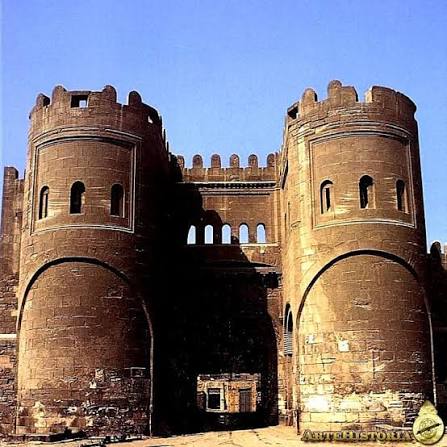
Bab al-Futuh's design reflects a deliberate shift toward serious military engineering rather than a purely symbolic boundary marker. The gate's two massive rounded towers, built from solid limestone quarried in the Mokattam Hills, flank a recessed stone archway. The curved shape of the towers was a deliberate defensive choice: rounded surfaces deflect projectiles more effectively than flat walls, reducing structural stress during an attack. This rounded design set Bab al-Futuh apart from its twin gate, Bab al-Nasr, which used square towers instead.
Higher up, each tower contains defensive rooms with arrow-slit windows set into recessed panels, allowing defenders to fire on attackers while staying protected. A stone platform once connected the two towers above the entrance, featuring shafts through which defenders could pour boiling oil or water onto anyone attempting to breach the gate below, an early forerunner of the machicolations later used across Islamic military architecture.
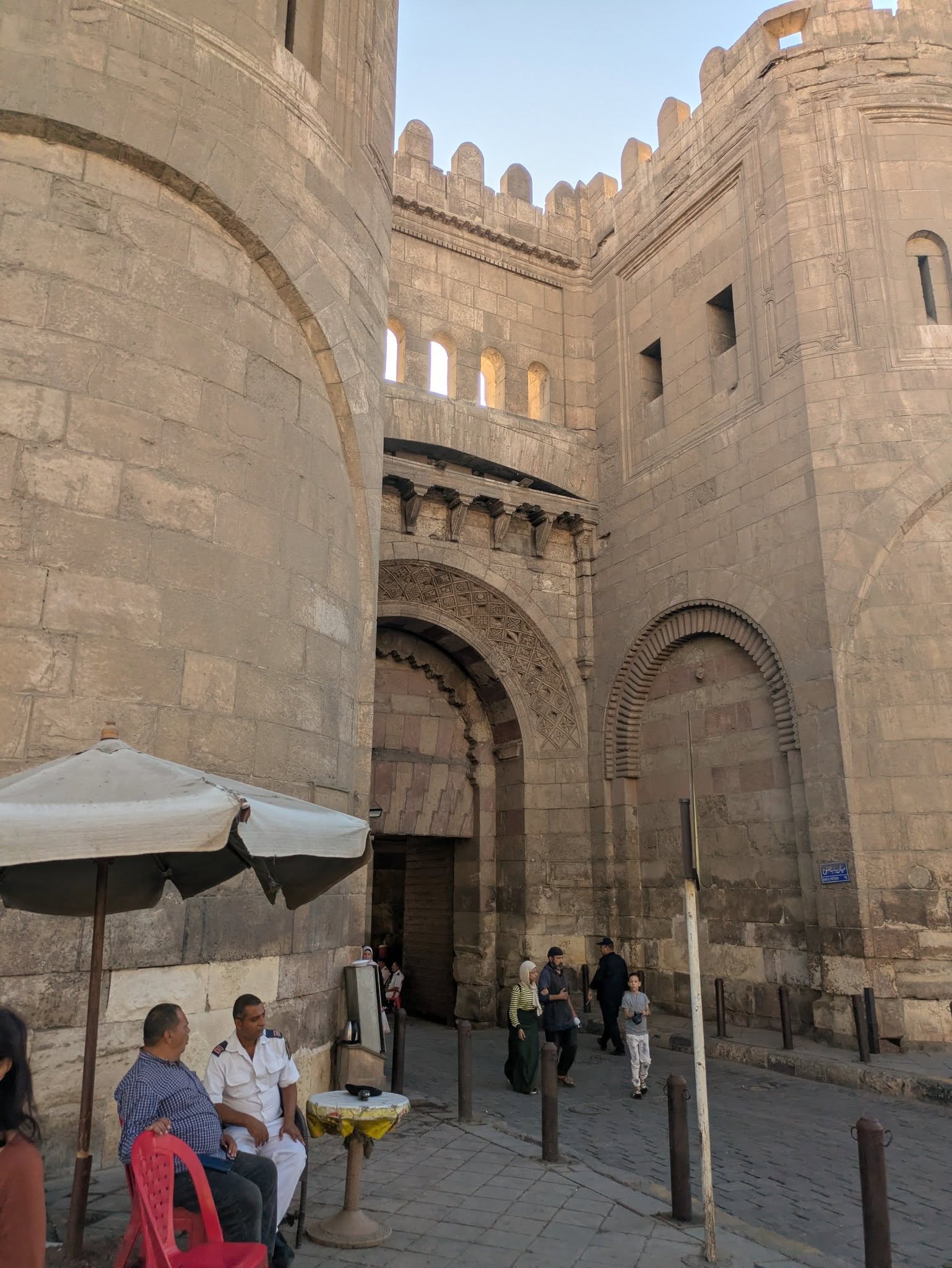
The entrance itself carries decorative as well as defensive details. Above the archway, a Kufic inscription honors Caliph al-Mustansir, and two of the carved brackets supporting the stone shelf above the gate are shaped like ram's heads, a symbol linked to Mars and to the founding of Cairo (al-Qahira) itself. Nearly a thousand years later, this stonework remains largely intact, giving visitors a rare, direct look at Fatimid-era military design.
Bab al-Futuh vs. Bab al-Nasr and Bab Zuwayla
Bab al-Futuh is one of three surviving gates from Cairo's Fatimid-era walls, alongside Bab al-Nasr and Bab Zuwayla, and understanding what sets each apart makes a visit to Islamic Cairo easier to plan.
Bab al-Nasr, the "Gate of Victory," stands directly across from Bab al-Futuh at the northern end of Al-Muizz Street and was completed in the same year, 1087. The clearest difference between the two is structural: Bab al-Nasr's towers are square, while Bab al-Futuh's are rounded, making the two gates easy to tell apart even from a distance. Bab al-Nasr also carries an inscription considered the earliest surviving example of a Shi'i religious creed on a Fatimid monument in Cairo.
Bab Zuwayla sits further south, at the opposite end of Old Cairo's original walled city, and was completed five years later, in 1092. Like Bab al-Futuh, it has rounded towers, but it's best known today for the two minarets added on top of it in the 15th century as part of the neighboring Mosque of Sultan al-Muayyad, giving it a distinctly different silhouette from the other two gates.
Together, the three gates formed a single connected defensive system under Badr al-Jamali, and walking between them today traces the original perimeter of Fatimid Cairo.
What to See Around Bab al-Futuh Today
Bab al-Futuh sits in El-Gamaleya, one of the most historically dense districts in Islamic Cairo, and several major Fatimid-era sites are within easy walking distance.
The most significant is the Mosque of al-Hakim, located just south of the gate at the end of Al-Muizz Street. Construction began in 990 AD under Caliph al-Aziz and was completed in 1013 by his son, al-Hakim, making it one of the oldest surviving mosques in Cairo and the second-largest after the Mosque of Ibn Tulun. The mosque was originally built outside the city walls and was only enclosed within Cairo's defenses when Badr al-Jamali rebuilt them in the late 11th century, the same project that produced Bab al-Futuh itself. Its two minarets are among the oldest in the city, and one of its original gateways once opened directly onto Bab al-Futuh.
From Bab al-Futuh, Al-Muizz Street runs south through the heart of Islamic Cairo, passing centuries of mosques, sabils, and historic houses on the way to Khan el-Khalili, Cairo's best-known bazaar. The gate, the mosque, and this stretch of Al-Muizz Street sit close enough together to explore on foot in a single outing.
Visiting Bab al-Futuh: Access, Hours, and Practical Tips
Bab al-Futuh stands at the northern end of Al-Muizz Street in El-Gamaleya, within Islamic Cairo, roughly 20–30 minutes from downtown Cairo depending on traffic. The area is best reached by taxi or ride-hailing app, since the surrounding streets are narrow and pedestrian-focused once you arrive.
The gate is open to visitors during daytime hours, and because it sits directly on Al-Muizz Street, it's easy to combine with a walk through the surrounding district rather than visiting in isolation. Given how often opening hours and access details shift for historic sites in Cairo, it's worth confirming the current schedule locally or with a guide on the day of your visit.
Comfortable, closed-toe shoes are worth wearing, since the surrounding streets are uneven cobblestone and can get crowded. As with the mosques nearby, modest dress is a reasonable default for this part of Islamic Cairo, even though Bab al-Futuh itself isn't a religious site.
Best Time to Visit and Photography Tips
The most flattering light on Bab al-Futuh's stonework comes in the late afternoon, when low sunlight catches the texture of the limestone and brings out the carved details around the archway and brackets. Early morning offers a similar quality of light with a different mood, since the sun hasn't yet risen high enough to flatten the shadows on the towers.
For photographing the gate itself, standing back on Al-Muizz Street gives the clearest view of both towers and the full recessed archway in one frame. Getting closer rewards you with the finer carving detail higher up on the towers, including the ram's-head brackets and the Kufic inscription above the entrance.
Because Bab al-Futuh sits at the start of Al-Muizz Street, it pairs naturally with a walk south toward the Mosque of al-Hakim, letting you photograph the gate and continue exploring the district in the same trip.