How the Rosetta Stone Was Deciphered: The Full Story
What the Rosetta Stone Actually Is
The Rosetta Stone is a fragment of a larger stone slab carved in 196 BC, inscribed with a single decree issued by Egyptian priests at Memphis in honor of the young pharaoh Ptolemy V Epiphanes. What makes it extraordinary is not the decree itself, but the fact that it was carved in three scripts on the same stone: hieroglyphic, the formal script used for religious and royal texts; Demotic, the everyday administrative script of Ptolemaic Egypt; and Ancient Greek, the language of the ruling dynasty. Because scholars could already read Greek, the stone offered something no other Egyptian artifact had: a translation key.
Found Near a Fort by the Nile
In July 1799, French soldiers under Napoleon Bonaparte's Egyptian campaign were rebuilding a defensive structure, Fort Julien, near the town of Rosetta, known locally as Rashid, in the Nile Delta. Workers noticed a large inscribed slab built into an old wall. Napoleon's scholars recognized its potential value almost immediately and had copies made and circulated across Europe well before the stone itself ever left Egypt. Those early printed copies mattered, because the stone would not stay French for long.
Passing to British Hands
After French forces surrendered to British and Ottoman troops in 1801, the Treaty of Alexandria required France to hand over antiquities collected during the campaign, including the Rosetta Stone. It arrived in England in 1802 and has been held by the British Museum in London ever since, where it remains one of the most visited objects in the museum today.
Thomas Young and the First Real Progress
The British polymath Thomas Young began serious work on the Demotic and hieroglyphic texts around 1814. Young correctly guessed that the hieroglyphic symbols enclosed in an oval frame, a cartouche, spelled out the name Ptolemy, and he identified several signs that behaved phonetically rather than purely symbolically. It was a genuine breakthrough, though Young stopped short of proving that hieroglyphic writing functioned as a full phonetic system.
Champollion's Breakthrough in 1822
Jean François Champollion, a French linguist fluent in Coptic, the last living descendant of the ancient Egyptian language, built directly on Young's work and on his own comparison of royal names in cartouches from the Rosetta Stone and other inscriptions. In September 1822, he announced in a letter to the Académie des Inscriptions, known as the Lettre à M. Dacier, that hieroglyphic writing combined phonetic signs with symbolic ones, and that this system had been used consistently for both foreign and native Egyptian names. Two years later, his Précis du système hiéroglyphique laid out the full grammar of the script.
Why This Mattered Beyond One Stone
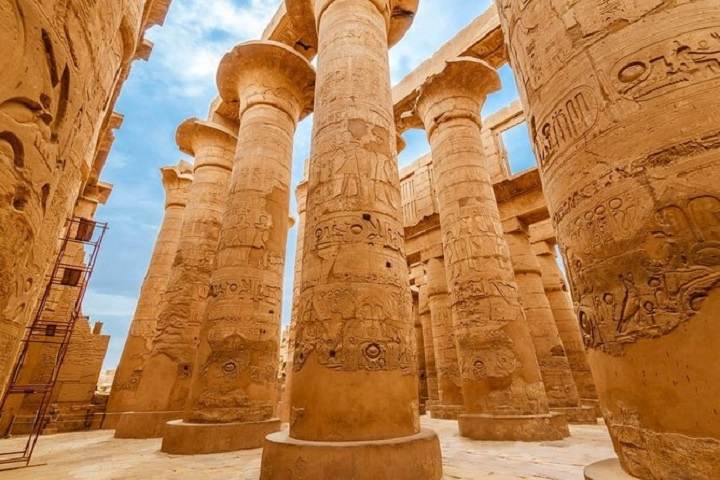
Champollion's decipherment did not just solve one inscription, it opened every hieroglyphic text in Egypt to modern reading: temple walls, tomb inscriptions, royal decrees, and thousands of papyri that had sat unreadable for over a millennium. Everything historians now know about pharaohs' names, religious texts, and daily administrative records from ancient Egypt traces back to the method Champollion built on this stone.
Seeing the Legacy Today
The Rosetta Stone itself remains in London, and Egypt has repeatedly and publicly requested its return, a debate that continues without resolution as of this writing. Travelers who want to understand the writing system it unlocked, rather than the stone itself, can do that in Egypt: the Egyptian Museum in Cairo and the Grand Egyptian Museum hold thousands of hieroglyphic inscriptions, and Aten Tours' private Cairo tours are built to walk visitors through exactly how these texts are read, with an Egyptologist guide rather than a general tour script.