Cleopatra and the Ptolemaic Dynasty: How Greek Pharaohs Ruled Egypt for 300 Years
How Alexander the Great's General Became Pharaoh of Egypt
Ptolemy I Soter, a Macedonian general who served under Alexander the Great, became pharaoh of Egypt in 305 BCE, founding the dynasty that ruled the country until Cleopatra VII's death in 30 BCE. When Alexander died in Babylon in 323 BCE at thirty-two, without naming an heir, his empire split among his generals. Ptolemy asked for Egypt specifically, and he knew what he was doing: it was rich, defended by deserts on both sides, and easier to hold than the territories his rivals were tearing each other apart over.
He ruled first as a satrap, a governor acting in Alexander's name, before dropping the pretense in 305 BCE and crowning himself pharaoh. He kept the pharaonic title, the temple-building, and the religious rituals that had legitimized Egyptian kings for millennia. He also kept Greek as the language of government, Greek gods worshipped next to Egyptian ones, and a royal court that looked nothing like the ones before it.
This is the detail most retellings skip: Ptolemy wasn't pretending to be Egyptian. He ruled as a Greek king who had also become pharaoh, and his family kept that arrangement running, largely unchanged, for 275 years of the Ptolemaic period in Egypt.
Alexandria: The Ptolemies' Greek Capital on Egyptian Soil
Alexandria became the capital of Ptolemaic Egypt in 305 BCE, replacing Memphis after nearly three thousand years as the seat of Egyptian power. Alexander the Great had founded the city in 331 BCE on the Mediterranean coast, choosing the site for its harbor rather than any connection to the Nile Valley's traditional centers. The Ptolemies built on that choice deliberately: a Greek city, laid out on a grid by the architect Dinocrates, facing Europe instead of Africa.
The population reflected that design. Greeks filled the administration and the army. Egyptians worked the land and staffed the lower levels of government, mostly excluded from real power for the dynasty's first century. Jewish communities settled in their own quarter and grew large enough that parts of the Hebrew Bible were translated into Greek there, a project later called the Septuagint. Add merchants, sailors, and scholars drawn from across the Mediterranean, and Alexandria became something Egypt had never had before: a genuinely cosmopolitan capital that most Egyptians living upriver in Thebes or Elephantine would barely have recognized as Egyptian at all.
That tension between the Greek capital and the ancient land it governed shaped almost every decision the Ptolemies made for the next 275 years.
Blending Two Worlds: How the Ptolemies Ruled as Pharaohs
The Ptolemies ran two separate systems of legitimacy at once: Greek kingship for their own court and Egyptian pharaonic tradition for everyone else. In Alexandria, they were Greek monarchs, worshipped through Greek-style ruler cults and referred to by Greek titles. Up the Nile, temple walls carved them in full pharaonic regalia, performing the same rituals every pharaoh had performed since the Old Kingdom, offering to Egyptian gods in the traditional poses.
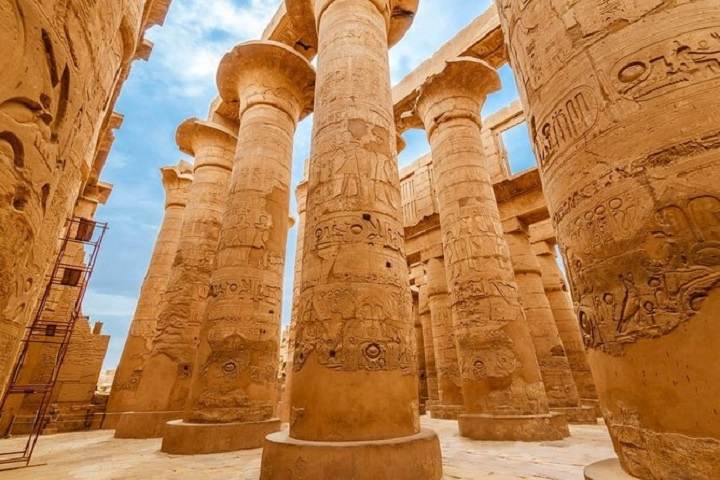
This wasn't hypocrisy so much as strategy. Egyptian priests held real religious authority and controlled temple wealth, so the Ptolemies funded temple construction on a massive scale to keep that power on their side. Several of Egypt's most complete surviving temples date from this period rather than from the pharaonic dynasties tourists usually associate with ancient Egypt: the Temple of Edfu, dedicated to the falcon god Horus, and the Temple of Dendera, dedicated to Hathor, were both built almost entirely under Ptolemaic rule. Ironically, these Greek-era temples are often better preserved than the New Kingdom monuments at Luxor and Karnak, simply because they were buried in sand or built over for longer before modern excavation began.
Some Ptolemies took the fusion further than others. Ptolemy V, still a child when he took the throne, is the pharaoh named on the Rosetta Stone, the trilingual decree that later let Jean-François Champollion decipher hieroglyphics. A handful of later Ptolemies also adopted Egyptian-style sibling marriages, following the pattern of Egyptian royal families before them rather than Greek custom, which had no such tradition.
Cleopatra VII: The Last Pharaoh of Egypt
Cleopatra VII took the throne in 51 BCE at eighteen, ruling first alongside her brother Ptolemy XIII and later her son Ptolemy XV Caesarion. She was the first Ptolemy in nearly three centuries known to have learned Egyptian, alongside Greek and several other languages, and she styled herself as the living embodiment of the goddess Isis to strengthen her standing with Egyptian priests and subjects.
Her reign faced real problems from the start: a devalued currency, food shortages from poor Nile floods, and a Roman Republic increasingly willing to interfere in Egyptian affairs. She managed Rome through personal alliances rather than military strength, first with Julius Caesar, with whom she had a son, and later with Mark Antony, with whom she had three children.
Cleopatra, Caesar, and Mark Antony: Politics and Survival
Cleopatra met Julius Caesar in 48 BCE after her brother Ptolemy XIII tried to seize sole power, and Caesar's backing secured her throne. After Caesar's assassination in 44 BCE, she allied with Mark Antony, one of Rome's rival power brokers, forming both a political partnership and a relationship that produced three children. Antony gave Cleopatra control over former Ptolemaic territories in the Levant, restoring some of the empire's earlier reach, in exchange for funding his military campaigns against Parthia.
This alliance put Cleopatra directly against Octavian, Caesar's heir and Antony's rival for control of Rome, setting up the conflict that would end the dynasty.
The Fall of the Ptolemaic Dynasty and the Battle of Actium
Octavian defeated the combined fleet of Antony and Cleopatra at the Battle of Actium in 31 BCE, off the coast of Greece. Both fled to Alexandria, and within a year both were dead by suicide as Octavian's forces closed in, Antony in August 30 BCE and Cleopatra shortly after. Her son Caesarion, briefly recognized as Ptolemy XV, was executed on Octavian's orders.
Egypt became a Roman province in 30 BCE, ending 275 years of Ptolemaic rule and closing the last independent kingdom to emerge from Alexander the Great's empire.