Sultan Hassan Mosque, Cairo: History, Architecture, and Visitor Guide
What Is the Sultan Hassan Mosque?
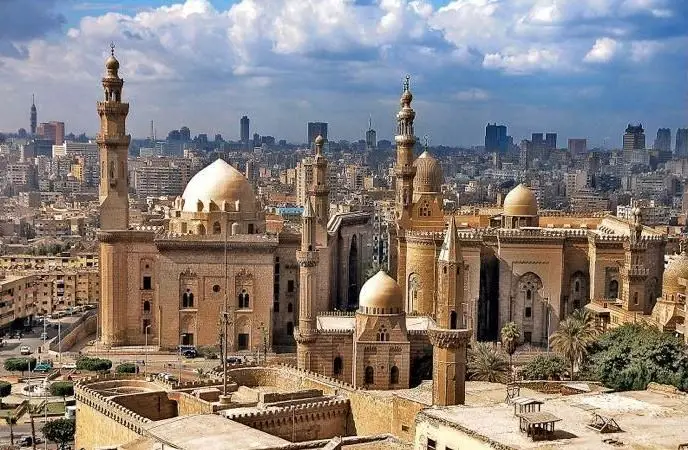
The Sultan Hassan Mosque is a 14th-century mosque, madrasa, and mausoleum complex in Islamic Cairo, built between 1356 and 1363 under the Mamluk sultan an-Nasir Hasan. Covering roughly 8,000 square meters, it ranks among the largest mosques in the world by footprint and is widely regarded as the most complete surviving example of Bahri Mamluk architecture in Egypt.
Unlike a simple prayer hall, the complex was designed as a teaching institution. It originally housed four madrasas — one for each of the four main schools of Sunni Islamic law: Hanafi, Maliki, Shafi'i, and Hanbali — alongside a hospital, kitchens, and living quarters for students and staff. This combination of religious, educational, and funerary functions in a single monumental building is what sets it apart from most other mosques in Cairo.
It sits in Salah El-Din Square (Citadel Square), directly facing the 19th-century Al-Rifa'i Mosque and a short walk from the Cairo Citadel. The surrounding area, known as Islamic Cairo, is part of Historic Cairo's UNESCO World Heritage designation.
History: An Ambitious Sultan Who Never Saw His Mosque Finished
Sultan Hassan came to power twice — first at age 13 in 1347, then again in 1354 after years of being sidelined by rival Mamluk emirs. Construction on the mosque began in 1356, funded in part, according to some accounts, by the confiscated estates of plague victims from an earlier Black Death outbreak that had swept through Cairo.
The project was never finished in Hassan's lifetime. In 1361, a revolt led by his own emirs deposed him, and he was killed shortly after — his body was never recovered. Construction continued under his successors and wrapped up around 1363, overseen by the emir Bashir al-Gamdar.
That unresolved ending shows up inside the building itself: the mausoleum Hassan commissioned as his own tomb stands empty. His sons are buried there instead. Some historians also note that stone blocks for the mosque may have been sourced from structures near the Giza plateau, though this detail is debated rather than firmly documented.
Mamluk Architecture at Its Peak — Why It's Called Egypt's "Fourth Pyramid"
Historians and travelers have called the Sultan Hassan Mosque Egypt's "fourth pyramid" for centuries — a comparison meant to place it alongside Giza's pyramids as the defining monument of its era, this time for Islamic rather than Pharaonic Egypt. The French orientalist Gaston Wiet ranked it among the finest works of Arab architecture anywhere, citing its dome, minaret height, and density of decoration.
The scale explains the reputation. The main facade runs roughly 150 meters along its longest side and rises about 38 meters high, with a recessed entrance portal alone measuring close to 38 meters deep — one of the largest in Mamluk architecture. One of its minarets reaches roughly 84 meters, making it one of the tallest minarets in historic Cairo.
Architecturally, the complex follows a cruciform plan: four iwans (vaulted, three-walled halls open to a central courtyard) arranged around a shared open space, each iwan serving one of the four Sunni madrasas. The main iwan, facing the qibla wall toward Mecca, carries the richest decoration — marble paneling and a wraparound Kufic inscription band.
Inside the Complex: Courtyard, Liwans, and the Empty Mausoleum
Visitors enter through a dark, sloped passage lined with stalactite-like muqarnas carvings before the space opens into the central marble courtyard, where a fountain once served worshippers for ablution before prayer.
Each of the four surrounding liwans functioned as a classroom for one madrasa, and the height and scale of the arches — among the largest vaulted spans built before the modern era — are best appreciated by standing at the courtyard's center and looking up.
Behind the qibla iwan sits the mausoleum, reached through a bronze door. Its dome, rebuilt after a partial collapse, rests on muqarnas pendentives that let morning light filter down into the chamber in a way few other Mamluk buildings replicate. The tomb here holds Sultan Hassan's sons rather than the sultan himself — an unusual detail that tends to surprise first-time visitors expecting a straightforward royal burial site.
Sultan Hassan Mosque vs. Al-Rifa'i Mosque: What's the Difference?
The two mosques face each other across Salah El-Din Square, and a single combined ticket typically covers both — which is why most visitors see them together rather than separately.
Al-Rifa'i Mosque is the newer of the pair, built between 1869 and 1912 under Khushyar Hanim, mother of Khedive Ismail, and completed as a royal mausoleum for the Muhammad Ali dynasty — it holds the tombs of King Fuad I, King Farouk (Egypt's last monarch), and Iran's last Shah, Mohammad Reza Pahlavi. Architecturally, it was deliberately designed to echo Sultan Hassan's scale and twin-minaret silhouette, but in a neo-Mamluk style with European Beaux-Arts influences and richer painted interior decoration.
Sultan Hassan Mosque remains the older, structurally purer example of 14th-century Mamluk design — starker, more austere, and built as a teaching institution rather than a mausoleum. Seeing both back to back is one of the clearest ways to compare five centuries of Islamic architectural evolution in Cairo in a single stop.
Visitor Information: Hours, Tickets, and Dress Code
The mosque is generally open daily, though reported hours vary by source — most list opening around 9:00 AM with last entry in the mid-to-late afternoon. (Hours fluctuate seasonally and should be confirmed close to your visit date — flagged for verification.)
Entry is usually sold as a combined ticket covering both Sultan Hassan Mosque and Al-Rifa'i Mosque. Reported prices vary across sources, which suggests recent changes — (exact current price flagged for verification before publishing).
As an active place of worship, modest dress is required: shoulders and knees covered for everyone, and a headscarf for women. Shoes come off before entering the prayer areas — plastic bags are sometimes provided to carry them through. Non-Muslim visitors are generally welcome outside of prayer times, though it's worth checking locally if visiting during Friday midday prayers.
Best Time to Visit and How to Get There
Early morning is the strongest window — light comes through the mausoleum's dome at a low angle, the courtyard is nearly empty, and the heat hasn't built up yet. Weekday visits (Monday to Thursday) tend to be quieter than weekends.
The mosque sits in the Islamic Cairo district near the Citadel, roughly a 20–30 minute drive from downtown Cairo depending on traffic. Taxis and ride-hailing apps are the most straightforward way to reach it, since the surrounding streets are pedestrian-heavy and not always clearly signed for first-time visitors navigating independently.
Nearby Attractions
Beyond Al-Rifa'i Mosque directly across the square, the Cairo Citadel is a short walk away and worth combining into the same outing — it houses the Mosque of Muhammad Ali and offers panoramic views over old Cairo. The Ibn Tulun Mosque, one of Cairo's oldest surviving mosques, and the markets of Khan el-Khalili are both within reasonable reach for travelers building a full day around Islamic Cairo.