Baalbek and Anjar: A Guide to Lebanon's Ancient Sites
Baalbek and Anjar at a glance
Choose Baalbek if you want monumental Roman architecture. Choose Anjar if you want a rare, well-preserved plan of an early Islamic city. Both sit in the Bekaa Valley and both were inscribed by UNESCO in 1984. Baalbek lies roughly 85 km east of Beirut, and Anjar about 60 km east of the capital, close to the Syrian border. They are about an hour apart by road, so they fit into one long day, although Baalbek deserves the larger share of your time. Both also lie in an area where government travel advice is stricter than for the rest of Lebanon, so read the last section of this guide before you plan.
Baalbek: Roman temples on an imperial scale
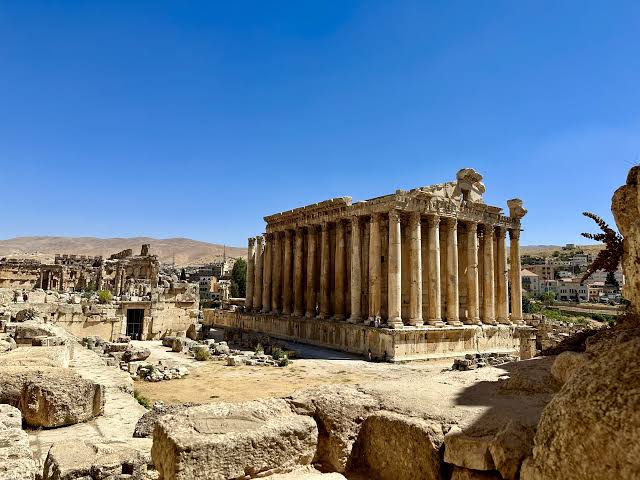
Baalbek was a sanctuary long before Rome arrived. The Romans, who called the town Heliopolis, turned it into one of the largest religious complexes of the empire. Over roughly two centuries, starting in the last quarter of the 1st century BC, they built the temples of Jupiter, Bacchus and Venus, and the UNESCO listing also covers the Temple of Mercury and the Odeon. The Temple of Jupiter was the main sanctuary, famous for columns about 20 m high and for the huge stones of its terrace. Only six of its columns still stand.
The Temple of Bacchus is the best preserved and the one most visitors remember. It is larger than the Parthenon in Athens, and its monumental doorway and rich carving are exceptional even by Roman standards. Smaller details reward a slow walk, such as the round Temple of Venus, the great courtyards and the pink granite columns that Trajan's builders brought from Aswan in Egypt. A museum in the tunnels beneath the courtyard of the Temple of Jupiter adds context. Allow two to three hours, and ask a guide to point out the enormous cut stones in the foundations, which are among the biggest ever moved by ancient builders. In the nearby quarry, a colossal block known as the Stone of the Pregnant Woman still lies where it was cut.
Anjar: an 8th-century Umayyad city built on a grid
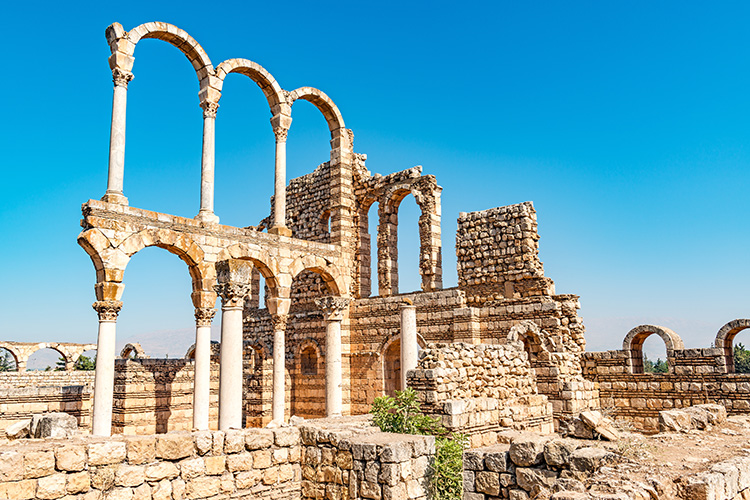
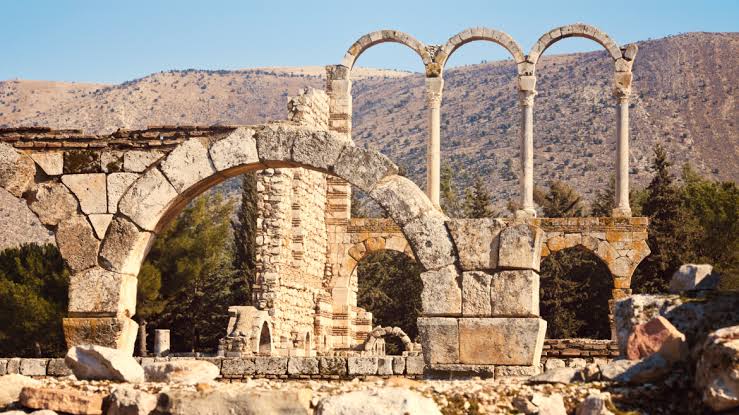
Anjar is far smaller and quieter than Baalbek, but it is unusual. It was founded in the early 8th century by the Umayyad caliphs and abandoned only a few decades later, so what survives is above all a complete town plan. Two colonnaded main streets cross at a central tetrapylon and divide the walled city into four quarters, following the Roman model. The enclosure measures roughly 310 by 370 m, with walls about 7 m high. Inside you walk past the remains of a palace, a mosque, baths, shops and houses, and UNESCO describes the site as a rare, precisely dated example of Umayyad urban planning.
Allow one to one and a half hours for Anjar. Standing columns, arches and sections of wall make it easy to picture the streets. The modern town next to the ruins was settled by Armenian families in the 20th century, and its restaurants make it a good lunch stop.
Baalbek or Anjar: which one to choose
If you can only visit one, choose Baalbek. Its scale and sculpture have no equal in Lebanon, and Anjar is the lesser known of the two. Choose Anjar if you are more interested in early Islamic history, prefer a short and calm visit, or have limited time. For architecture and photography, Baalbek is stronger. For understanding how cities were planned in the 8th century, Anjar is more informative. Families with older children often enjoy the scale of Baalbek, while Anjar suits shorter attention spans. For food, the Armenian town of Anjar and the wineries of the valley, such as Château Ksara and Château Kefraya, give a good break between the two sites. For quiet, arrive at either site early in the morning.
Getting there and combining both in one day
Anjar is about 60 km from Beirut and Baalbek about 85 km, so most travelers join a guided Bekaa day trip or hire a driver rather than rely on public transport. A common order is Beirut to Anjar in the morning (around 1.5 hours), lunch in the Armenian town or at a winery, then on to Baalbek for the afternoon, about an hour further. The return to Beirut takes two to two and a half hours. Checkpoints and traffic on the mountain road over Dahr el-Baidar can add time, so plan a full day and avoid reaching Baalbek late. The best seasons are spring and autumn. Winters in the valley are cold and the ground at Anjar can be muddy, while summers are hot at the exposed Baalbek site.
Before you go: check current travel advice
Baalbek and Anjar lie in a part of Lebanon that many governments treat more strictly than the coast. As of 19 October 2026, Australia advises Do not travel to Lebanon overall and specifically warns against travel to the Baalbek-Hermel governorate and to the part of the Bekaa governorate east of the Litani River, citing clashes between armed groups and air strikes. The United States keeps a Level 4 Do Not Travel advisory for the whole country. Check your own government's current advice for these exact areas before you book anything, and confirm that your travel insurance covers them, since many policies do not cover travel against official advice. Confirm the opening hours and ticket prices of both sites shortly before your visit, and verify the status of flights into Beirut. This article reflects information available in October 2026 and describes the heritage sites. It does not replace official advice.