The Avenue of Sphinxes in Luxor: History, Restoration, and How to Visit
- What Is the Avenue of Sphinxes?
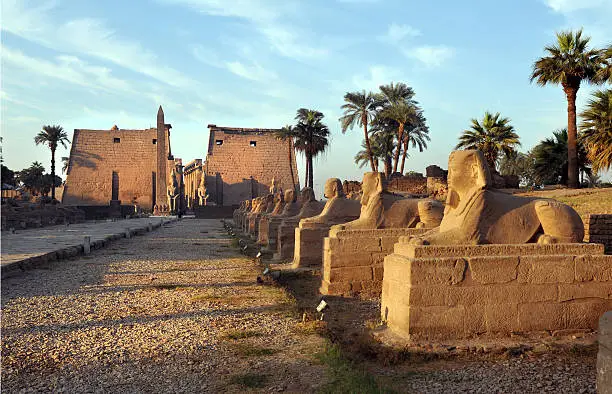
The Avenue of Sphinxes, also known as El-Kebbash Road or the Road of the Rams, is a 2.7-kilometer processional avenue in Luxor, Egypt, linking Karnak Temple in the north to Luxor Temple in the south. Both sides of the road are lined with sphinx statues carved from sandstone, spaced at regular intervals that would have taken a walking procession close to an hour to cross in ancient times.
The avenue connects two temples with different religious functions. Karnak Temple was dedicated to Amun-Ra, king of the gods, while Luxor Temple served the ritual renewal of the pharaoh's divine kingship. A priest or pharaoh moving along the road passed from one form of worship to another, from the domain of the state god to the domain of living kingship.
.The earliest work on the avenue dates to Amenhotep III's reign, roughly fourteen centuries before Christ., Nectanebo I later rebuilt and completed much of the avenue during the 30th Dynasty, around the 4th century BC, which is why most of the surviving sphinx statues along the route date from his reign rather than Amenhotep III's original construction.
Sections of the avenue are paved with the same sandstone blocks that lined the processional route in antiquity, worn smooth in places from both ancient foot traffic and modern visitors walking the same 2.7 kilometers today.
- History: From Amenhotep III to Nectanebo I
Construction of the Avenue of Sphinxes began during the reign of Amenhotep III, around 1390–1352 BC, as part of a broader building program that also expanded Luxor Temple itself. His original avenue connected the two temple precincts, but only fragments of this earliest phase survive today, mostly foundation traces uncovered during excavation.
The avenue as most visitors see it now dates largely to Nectanebo I, who ruled from 380 to 362 BC during the 30th Dynasty, Egypt's last native royal dynasty before Persian and later Greek rule. Nectanebo I rebuilt the road on a grander scale, adding new rows of sphinx statues along its full length and formalizing it as a single, continuous processional route rather than a series of connected temple approaches.
Between these two building phases lies roughly a thousand years of Egyptian history, spanning the New Kingdom, the Third Intermediate Period, and the Late Period. Statues along the avenue reflect this timeline, with clear stylistic differences in how the sphinxes were carved from one section to another.
By the Ptolemaic and Roman periods, the avenue had fallen out of active ceremonial use, and Nile silt gradually buried the road beneath the growing city. Centuries later, homes, mosques, and a church stood directly over parts of the route, structures that Egyptian authorities eventually removed as part of the excavation project, a process that required relocating residents and businesses from the area.
- Human-Headed vs. Ram-Headed Sphinxes: What's the Difference?
Two distinct types of sphinxes line the Avenue of Sphinxes, and which one a visitor sees depends on where they're standing along the 2.7-kilometer route.
Near Karnak Temple, the statues are criosphinxes: lion bodies topped with ram heads, representing Amun-Ra, the chief god of Thebes. Several of these ram-headed sphinxes hold a small carved figure of the pharaoh between their front paws, a pairing of god and king that repeats down this section of the avenue.
Moving toward Luxor Temple, the statues shift to androsphinxes, human-headed sphinxes with the same lion's body, but a face modeled on the pharaoh rather than a ram. These represent royal power directly: the king himself as guardian, rather than the god he served.
The placement follows the temples on either end. Ram-headed statues cluster where the Amun-focused temple begins; human-headed statues take over as the road approaches Luxor Temple, the site tied to kingship and renewal. A visitor walking the full avenue passes through this shift in symbolism, from divine authority to royal authority, arriving at the temple built to reaffirm the pharaoh's connection to both.
- The Opet Festival: Why This Road Was Built
The Avenue of Sphinxes existed for one primary purpose: to carry the gods of Karnak to Luxor Temple once a year during the Opet Festival, ancient Thebes' most important religious event.
At the start of the festival, priests brought statues of the Theban Triad, Amun, his consort Mut, and their son Khonsu, out of their sanctuaries at Karnak Temple. Each statue traveled inside a gilded ceremonial bark, carried on the shoulders of priests or transported by boat along the Nile, moving south down the avenue toward Luxor Temple. Crowds gathered along the route, since this procession was one of the few times ordinary Egyptians could see statues normally kept hidden inside temple sanctuaries.
The festival ran for several weeks in its later, more elaborate form, and its purpose went beyond public spectacle. Inside Luxor Temple, away from public view, priests performed rituals believed to renew the pharaoh's divine authority and reaffirm his connection to Amun-Ra. The Opet Festival tied the king's legitimacy directly to this yearly journey between the two temples.
The festival's timing followed the Nile's flood season, linking the renewal of kingship to the renewal of the land. Once the rituals at Luxor Temple concluded, the statues returned to Karnak along the same road, an event repeated annually for over a thousand years, from the New Kingdom through the Ptolemaic period.
- Rediscovery and Restoration: From Buried Road to 2021 Reopening
For most of the modern era, the Avenue of Sphinxes was invisible. Centuries of Nile silt buried the road, and the growing city of Luxor was built directly on top of it, until a chance excavation in 1949 brought the first statues back into view.
Egyptian archaeologist Zakaria Ghoneim uncovered the first eight sphinx statues that year, near Luxor Temple. The find confirmed that the ancient road described in historical texts still existed underground, and further excavation followed in phases over the following decades, each one uncovering more of the route while confirming how much of it lay beneath inhabited parts of the city.
Full-scale excavation accelerated from the early 2000s, when Egyptian authorities committed to uncovering the avenue's entire length. This stage of the project required removing homes, shops, and religious buildings, including mosques and a church, that had been built over sections of the road, along with relocating the residents and business owners living there. Archaeologists working on these later stages also found evidence of Roman-era additions and Coptic Christian modifications along parts of the route, layered on top of the original ancient structure.
The avenue officially reopened on November 25, 2021, in a ceremony organized by Egypt's Ministry of Tourism and Antiquities, with the full 2.7-kilometer route made accessible to the public for the first time in centuries. Excavation and documentation work have continued since the reopening, with archaeologists still confirming and cataloguing statues along less-restored stretches of the road.
- How to Visit: Access, Tickets, and Timing
There is no separate ticket for the Avenue of Sphinxes itself. Access is included with entry to either Karnak Temple or Luxor Temple, and visitors typically start at one temple and walk toward the other.
The full 2.7-kilometer route is not entirely open without payment at each end. About halfway along, a checkpoint separates the two accessible sections: reaching the far end requires a valid ticket for whichever temple that section leads to. Visitors who only bought a ticket for one temple can walk partway down the avenue from that side, then exit onto the surrounding streets rather than completing the full route through to the other temple.
The two ends of the avenue aren't in identical condition. The stretch closer to Luxor Temple is generally better preserved and more densely lined with statues, while the section nearer Karnak has faced more weathering and gaps in the original row of sphinxes. Visitors walking the entire route should expect it to take roughly 20 minutes at a steady pace, or closer to an hour with stops to view individual statues and inscriptions.
- Day vs. Night, Which Is Better?
The avenue is lit at night, but not accessible along its full 2.7-kilometer length after dark — most Luxor sites, including the temples that anchor each end, close by around 8 PM, with last entry roughly an hour earlier. Night visitors typically manage a few hundred meters from either the Luxor Temple or Karnak Temple entrance, rather than the complete walk between them.
Daytime visits allow the full route and better visibility of carved detail: the wear patterns on the sandstone, inscriptions on statue bases, and the visible difference between ram-headed and human-headed sections. This matters more during Luxor's cooler months, from October to April, when midday heat isn't a deterrent.
From May through September, daytime temperatures in Luxor regularly exceed 38°C (100°F), which changes the calculation. Early morning or the evening lighting window becomes the more comfortable option, even though it means seeing only part of the avenue rather than walking the entire route.
The practical choice depends on the season and what a visitor prioritizes: those visiting outside summer, focused on inscriptions and the full length of the route, generally get more from a daytime walk; those traveling in peak heat, or mainly after the atmosphere of the lit statues at dusk, are better served visiting near one temple entrance in the evening.
- The Avenue of Sphinxes in a Luxor Itinerary
The avenue works best as a connector rather than a standalone stop, since it physically links the two sites most Luxor visits are built around: Karnak Temple and Luxor Temple.
A common approach is to start at Karnak in the morning, when the site is cooler and less crowded, spend two to three hours exploring its halls and courtyards, then walk the avenue south toward Luxor Temple rather than arranging separate transport between the two. This turns what would otherwise be a taxi ride into part of the sightseeing itself, following close to the same route processions once took during the Opet Festival.
Luxor's East Bank holds enough sites, Karnak, Luxor Temple, the avenue connecting them, and the Luxor Museum, to fill a full day on their own, before factoring in West Bank sites like the Valley of the Kings on a separate day.
Aten Tours' [Luxor Attractions tour] covers this East Bank route as a guided visit, pairing Karnak and Luxor Temple with the walk along the Avenue of Sphinxes, with entry tickets and transport arranged as part of the day.