The Great Hypostyle Hall: Karnak's Forest of Stone Columns
What Is the Great Hypostyle Hall?
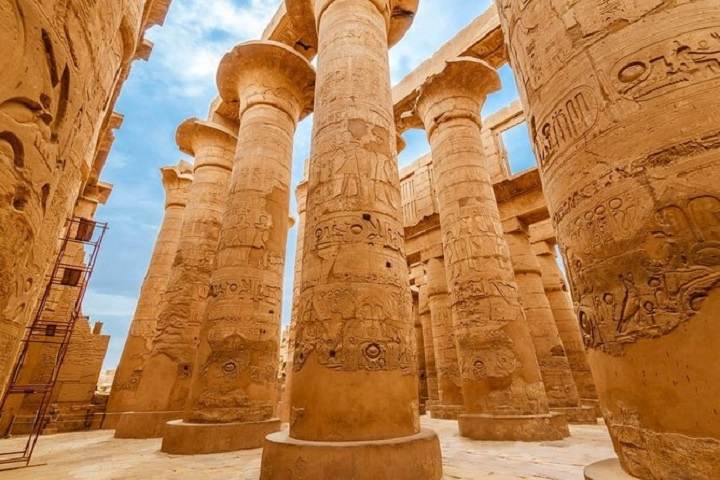
The Great Hypostyle Hall sits at the heart of the Karnak Temple Complex in Luxor, filling the space between the Second and Third Pylons. A hypostyle hall is a roofed space held up entirely by columns, and this one is the largest surviving example from the ancient world. It formed the main processional route toward the sanctuary of Amun-Re, the chief god of the Egyptian pantheon, and every pharaoh who walked through it did so as part of a religious rite, not a casual visit.
134 Columns, One Room
The hall covers close to 5,000 square meters, roughly the size of a football pitch, and holds 134 sandstone columns arranged in 16 rows. The twelve columns running down the central aisle stand about 21 metres tall, wide enough that several adults linking hands can barely circle one. The shorter side columns, still over 12 metres, carry papyrus-bud capitals, while the tall central columns are shaped like open papyrus flowers.
Built by Two Kings
Construction began under Seti I around 1290 BCE, who laid the column bases and decorated much of the northern half with finely carved reliefs. His son Ramesses II completed the hall and finished the southern half, though in a bolder, deeper carving style that visitors can still compare side by side today. Later rulers, including Ramesses IV, added their own inscriptions over the following centuries.
Light Inside a Forest of Stone
The central aisle stands taller than the columns on either side, and that height difference let the Egyptians cut stone grilles into the gap, a technique called clerestory lighting. Karnak holds some of the earliest known evidence of this method anywhere in the ancient world, and it explains how a hall this dense with columns wasn't left in total darkness.
Carvings That Record a Kingdom
Nearly every surface carries bas-reliefs: Seti I and Ramesses II are shown as chief priests before the gods, in military campaigns against Egypt's neighbours, and in offering scenes repeated across generations of pharaohs. Traces of the original paint, blues, reds, and yellows, still survive on the upper column shafts and ceiling blocks, giving a rare hint of how vivid the hall once looked.
Visiting the Hall Today
Early morning is the best time to see the columns before the heat and the crowds build, and the low light angle brings out the carved reliefs more clearly than midday sun. Comfortable shoes matter here since the ground is uneven sandstone, and a guide who can point out the Seti I versus Ramesses II carving styles adds far more than a self-guided walk through.
Seeing It in Context
Understanding the Hypostyle Hall on its own is one thing; seeing it as part of the full Karnak complex, alongside the Sacred Lake, the obelisks of Hatshepsut, and the avenue of ram-headed sphinxes, is another. Aten Tours' private Luxor and Karnak tour covers the hall with an Egyptologist guide who walks through the Seti I and Ramesses II sections in detail, at a pace built around your group rather than a fixed timetable.