Malkata Palace, Luxor: What Remains of Amenhotep III's Royal City
- What Is Malkata Palace?
Malkata Palace was the royal residence of Pharaoh Amenhotep III, built on Luxor's West Bank around 1350 BCE during Egypt's 18th Dynasty. Ancient texts called it "the House of Rejoicing," and it functioned as a working palace rather than a temple or tomb, a place for the king to live, govern, and celebrate, not a monument built for the afterlife.
The complex covered roughly 50 hectares of desert south of Medinet Habu, making it the largest known royal residence from ancient Egypt. It included private royal apartments, a grand audience hall, administrative buildings, workshops, and housing for staff. Amenhotep III used it especially during Akhet, the Nile flood season, when the annual inundation made parts of Thebes less accessible.
The palace takes its modern name, Malkata, from the Arabic for "the place where things are picked "up", a reference to the pottery shards and debris still scattered across the site. After Amenhotep III's death and his son Akhenaten's move to Amarna, Malkata was abandoned and slowly stripped of its mudbrick for reuse elsewhere, leaving the fragmentary ruins visible today.
- Who Lived There: Amenhotep III, Queen Tiye, and the Royal Family
Amenhotep III ruled Egypt from around 1391 to 1353 BCE, during one of the most stable and prosperous periods of the New Kingdom. Malkata was built as his primary residence away from the state temples of Karnak and Luxor, and he lived there with his Great Royal Wife, Queen Tiye.
Tiye's name appears alongside Amenhotep III's on official monuments and inscriptions far more often than earlier queens, which most Egyptologists read as a sign of unusual influence at court, though the exact scope of her role is still debated. Their household at Malkata also included their children, among them the prince who would later become Akhenaten and reshape Egyptian religion around the Aten sun disk.
The scale of Malkata reflects the diplomatic reach of Amenhotep III's reign. Egypt's correspondence with rulers across the Near East during this period was later recovered at Akhetaten (modern Tell el-Amarna) as the Amarna Letters and gives a sense of the volume of foreign contact the palace and its administration would have handled. Malkata wasn't isolated from that world; it was one of the places where that diplomacy played out.
- What You Can See Today
Malkata is not a restored monument. What survives is mostly foundations, low mudbrick wall stumps, and scattered pottery fragments spread across sandy, uneven ground. There are no standing columns, no painted temple walls, and no reconstructed hallsو visitors need some imagination to connect what's on the ground to the palace's original scale.
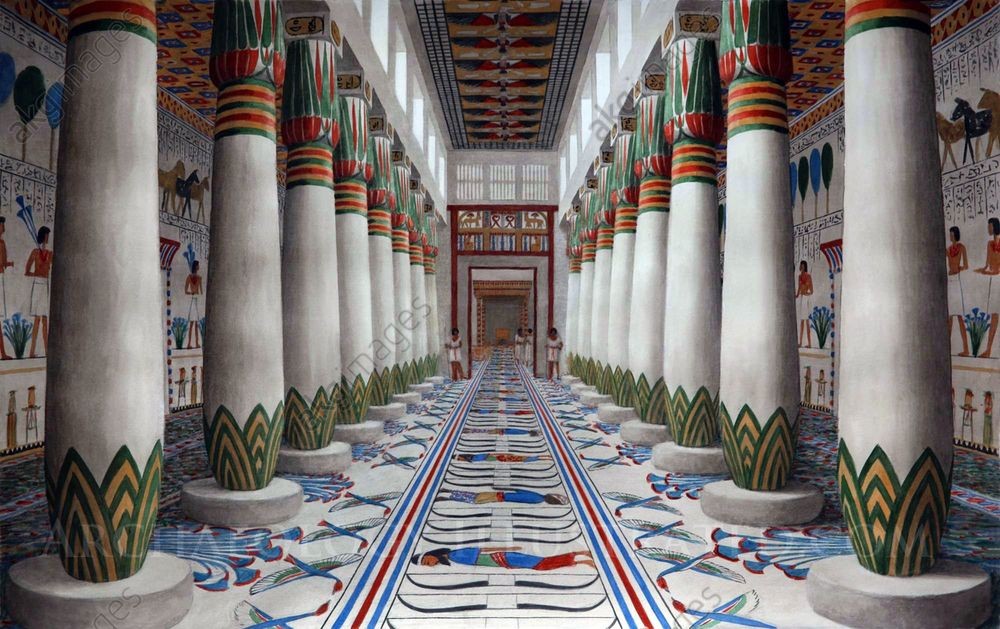
The site is loosely organized into a central palace area and a separate administrative zone. The central palace held the king's private apartments and the Great Audience Hall, once supported by rows of columns and decorated with painted scenes, though almost none of that decoration survives in place today. (Flag for verification: I'd confirm exactly where the recovered fresco fragments are now held before naming a specific museum.) The administrative zone contained bakeries, breweries, granaries, and stables that supplied the royal household with practical infrastructure rather than ceremonial space.
Because there's no ticket booth, signage, or visitor center, Malkata rewards people who already know some of its history before arriving. Without that context, the ruins can look like undifferentiated mounds of sand and brick. With it, the layout of a 3,400-year-old royal city starts to become readable on the ground.
- Kom el-Samak and Birket Habu: The Palace's Wider Landscape
Malkata wasn't a single buildingو it was the center of a much larger royal landscape, and two features beyond the main palace ruins are worth knowing about even if they're not easy to see clearly on the ground today.
Kom el-Samak sits south of Birket Habu and was a mudbrick platform built for Amenhotep III's Heb-Sed, the jubilee festival that renewed a pharaoh's rule. Its staircase held 20 painted steps decorated with bound captives representing Nubians, Syrians, and other foreign peoplesو a design meant so that anyone climbing toward the king's throne symbolically trampled Egypt's enemies underfoot. The same motif appeared inside the palace itself, on the steps leading to Amenhotep III's audience hall.
Birket Habu is the vast harbor lake Amenhotep III had excavated east of the palace, stretching roughly 2.5 kilometers to the south. The mounds of earth dug out to create it still rise along its edges today, and excavations have turned up jar sealings and provisioning labels tied to festival logisticsو physical evidence that Birket Habu functioned as a working harbor supporting the Sed festival's ceremonies, not just a decorative feature.
Neither Kom el-Samak's painted steps nor Birket Habu's original water are visible today; both survive mainly as landscape features; a guide familiar with the site can help identify them on the ground.
- Getting There and Practical Visiting Info
Malkata sits on Luxor's West Bank, south of Medinet Habu. Most visitors reach it by taxi, private car, or as an add-on to a broader West Bank itinerary, since there's no public transport route directly to the site and no fixed travel time, it depends on your starting point on the West Bank.
Access details are inconsistent across sources, and that inconsistency is worth flagging rather than glossing over: some report a standard entrance fee, while others describe no ticket office or formal entry point at all, visitors simply walking onto an open desert site. This kind of detail can change with little notice at remote sites, so confirm current access, any entry fee, and opening hours with a licensed local guide or your hotel before building a day around it.
There's no visitor center, shade, or facilities on-site, so sturdy footwear, water, sunscreen, and a hat matter more here than at Luxor's more developed monuments. Early morning is the more comfortable time to visit, both for temperature and light.
- Is Malkata Palace Worth Visiting?
Malkata is worth visiting if you're already spending time on Luxor's West Bank and want to see where a pharaoh actually lived, rather than only the temples built for the afterlife. It won't compete with the Valley of the Kings or Medinet Habu for visual impactو there's no dramatic architecture left standingو but it offers something those sites can't: a sense of the everyday scale of royal life under Amenhotep III, and the near-total absence of other visitors.
It's not a strong fit as a first-time, single-stop destination, and it's not necessary for a short Luxor trip focused on the major monuments. It makes more sense as an add-on for travelers with an extra half-day on the West Bank, a specific interest in Amenhotep III's reign, or a wish to see a site most tour groups skip entirely.