Precinct of Amun-Re: Karnak's Sacred Heart in Luxor
On the east bank of the Nile at Luxor, the Precinct of Amun-Re forms the largest and most visited section of the Karnak Temple Complex. Ancient Egyptians called the site Ipet-Isut "the most select of places," and for over a thousand years it served as the earthly home of Amun-Re, chief god of the Theban Triad alongside Mut and Khonsu.
Construction began modestly under the Middle Kingdom pharaoh Senusret I in the 20th century BCE, but the precinct grew into its present scale during the New Kingdom, roughly between 1550 and 1070 BCE. Close to thirty pharaohs added courts, chapels, and pylons over almost fifteen centuries, each leaving a mark on what became one of the largest religious complexes ever built.
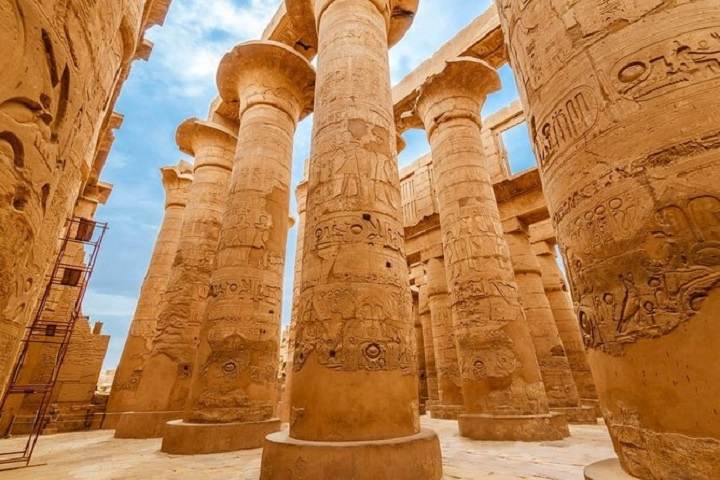
Its best-known feature is the Great Hypostyle Hall, begun under Seti I and completed by his son Ramesses II. The hall's 134 sandstone columns, some rising close to 21 meters along the central aisle, once supported a roof lit by clerestory openings, and traces of the original paint still survive near the ceiling.
Just before the hall, two obelisks were raised by Hatshepsut, one of them the tallest surviving obelisk in Egypt, cut from a single block of red granite. Its twin was removed in antiquity by the Roman emperor Constantine and re-erected in Rome, leaving Hatshepsut's obelisk to stand alone at Karnak as one of the site's most striking monuments.
To the south, the Sacred Lake once served the resident priesthood for ritual purification before ceremonies and symbolically represented the primordial waters from which Amun-Re was said to have emerged. Smaller shrines within the precinct, including the Temple of Ptah and the Temple of Khonsu, show how the site expanded well beyond its original core.
Today, the Precinct of Amun-Re is the only part of Karnak permanently open to the public, forming part of the Ancient Thebes UNESCO World Heritage Site. Visitors walk the same north-south and east-west axes once reserved for royal processions, past pylons, courts, and colossal statues that together trace nearly two thousand years of continuous building.
Today, the Precinct of Amun-Re is the only part of Karnak permanently open to the public, forming part of the Ancient Thebes UNESCO World Heritage Site. Visitors walk the same north-south and east-west axes once reserved for royal processions, past pylons, courts, and colossal statues that together trace nearly two thousand years of continuous building.