Colorful ancient Egyptian reliefs inside the Temple of Khnum at Esna

Temple of Khnum in Esna: Egypt's Buried Roman-Era Temple

In the middle of a busy Nile-side market town, a staircase drops visitors several meters below street level into a hall of towering columns most trave...

Ancient astronomical reliefs on the ceiling of Esna Temple

Temple of Khnum in Esna: Egypt's Buried Roman-Era Temple

Ancient columns and carved reliefs inside Esna Temple

Where the Temple of Khnum Stands, and Why Esna

The Temple of Khnum sits in Esna, a Nile-side town roughly 55 kilometers south of Luxor, built directly beneath the modern town's market square. Only the temple's hypostyle hall, or pronaos, survives above ground; the rest of the structure, including chambers likely dating back to the New Kingdom, remains buried under surrounding houses and streets and has never been fully excavated. Visitors descend a staircase to reach a sunken courtyard, arriving at a temple hall that sits well below the level of daily life passing by overhead.

Khnum: The Ram-Headed God Who Shaped Humankind

Khnum was worshipped as a creator god, depicted with a ram's head and credited in Egyptian belief with forming human bodies and their spirits on a potter's wheel before placing them in the womb. His cult centered on both Esna and the island of Elephantine near Aswan, where he was linked to the Nile's annual flood. At Esna, Khnum was worshipped alongside the goddesses Neith and Menhit, and inscriptions throughout the temple describe his role in creation using language found nowhere else in Egyptian religious texts.

The Hypostyle Hall: What Actually Survives Today

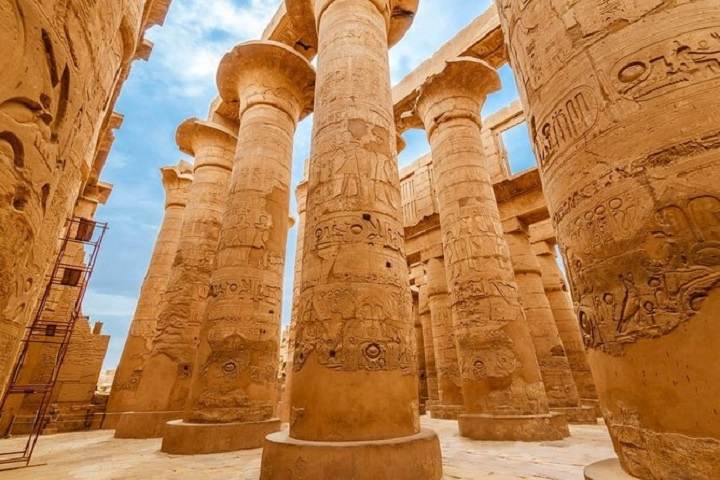
What visitors see today is the temple's pronaos, a hall of 24 columns arranged in six rows, each column topped with a different floral capital design representing plants such as papyrus, palm, and lotus. The walls and columns are covered in hieroglyphic inscriptions and reliefs of offering scenes, still legible despite centuries underground. Because the rest of the temple remains buried beneath the town, this hall is currently the only part of the Esna temple complex open to visitors.

A Zodiac Ceiling from the Roman Period

The hall's ceiling carries an astronomical scene showing the zodiac alongside traditional Egyptian decans, star groups used to track time through the night. This blend of Greco-Roman zodiac imagery with older Egyptian astronomical tradition reflects the period in which the hall was built, when Egyptian religious practice continued under foreign rule and absorbed new symbolic influences. Similar zodiac ceilings appear at only a small number of other Egyptian temples, making Esna's version a notable reference point for understanding this specific artistic phase.

Built and Decorated Under Roman Rule

Unlike most surviving Egyptian temples, the pronaos at Esna was constructed and decorated largely during the Roman period, with inscriptions bearing the cartouches of emperors including Claudius, Vespasian, Trajan, and later rulers into the third century CE. Roman emperors continued the pharaonic tradition of presenting themselves as legitimate rulers of Egypt through temple building, and Esna's hall stands as one of the clearest examples of this practice still standing today, centuries after Roman temples elsewhere had stopped being built.


The Restoration That Revealed Hidden Color

Beginning in 2018, an Egyptian-German archaeological mission spent years cleaning centuries of soot, dust, and bird droppings from the hall's ceiling and columns, work that gradually revealed the original blue, yellow, and red pigments beneath a layer of grime. The project also uncovered previously unreadable inscriptions and details in the reliefs that had been obscured for generations. The restoration drew international attention for showing, in unusually vivid color, how bright ancient Egyptian temples once looked before time and pollution dulled them.

Visiting the Temple Today

The Temple of Khnum is a regular stop on Nile cruise itineraries traveling between Luxor and Aswan, often paired with a walk through Esna's riverside market. Because the site sits below street level and the hall is compact, a guide who can point out specific column capitals, cartouches, and zodiac details adds real depth to a visit that could otherwise feel brief. An Aten Tours Nile cruise itinerary that includes a stop at Esna builds in time to see the temple properly rather than rushing through it between stops.
 

Why Choose Aten Tours

Travel with confidence with Aten Tours, where local expertise meets exceptional service. From carefully curated itineraries and handpicked experiences to seamless planning and dedicated support, we create personalized journeys designed around what matters most—comfort, quality, and unforgettable experiences across Egypt and beyond.

Secure Online Payment

Enjoy safe and secure online payments with full protection of your personal and financial information. Book your trips with confidence anytime, anywhere.

Help & Support

Travel with confidence knowing that our Help & Support team is always here for you. From booking to your return, we’re just one message away.

Tailored Travel Experiences

Your journey, your way. We design tailored experiences that match your style, ensuring comfort, flexibility, and unforgettable moments in every destination.

Client Testimonials

At Aten Tours, we are proud to create experiences that leave lasting memories. Read genuine feedback from travelers who explored Egypt’s wonders, enjoyed luxury holidays, and discovered the world with confidence and ease.

Traveling solo in Egypt with Aten Tour was one of the best decisions I made. As a 22-year-old female traveler, I was a little nervous before arriving, but I felt safe and well looked after from day one. Everything was well organized, my guide was knowledgeable, kind, and always happy to help, and I never had to worry about a thing. The whole trip was smooth, enjoyable, and filled with unforgettable moments. I'm so glad I chose Aten Tour and would definitely travel with them again.

Sarah
Sarah May 2026

My fiancé and I booked a private 5-day tour of Egypt with Aten Tours, covering Cairo, Aswan, Abu Simbel, and Luxor. From the moment we arrived, everything was perfectly organized. The team took care of every detail, making our trip completely stress-free. Our guides were knowledgeable, friendly, and passionate about Egypt's history, and every destination exceeded our expectations. Even after returning home, we still find ourselves talking about this unforgettable experience. We highly recommend Aten Tours to anyone looking for a well-planned and memorable trip to Egypt.

Thomas
Thomas May 2026

Traveling with Aten Tour made our vacation completely stress-free. Every hotel, transfer, and excursion was exactly as promised, and the team was always available whenever we had a question. We really appreciated the personal attention and warm hospitality throughout the trip. We came home with unforgettable memories and would definitely recommend Aten Tour to anyone planning a trip to Egypt.

Olivia
Olivia April 2026

We booked an 8-day trip with Aten Tour, and it turned out to be one of our favorite vacations. Everything was well organized from start to finish, which made traveling around Egypt really easy. We never felt rushed, the hotels were great, and the team was always helpful whenever we needed anything. Egypt had been on our bucket list for a long time, and we're so glad we chose Aten Tour for this experience.

Nicholas
Nicholas July 2026

Our family booked a tour with Aten Tour after reading several positive reviews, and they definitely lived up to our expectations. Communication before the trip was quick and helpful, and everything during the tour was exactly as described. The hotels were comfortable, the transportation was smooth, and the guides made every stop interesting with their stories and local knowledge. Egypt had always been a dream destination for us, and this trip made it even more memorable.

Emma
Emma June 2026

All FAQ about Egypt

Yes, Esna is a common stop on Nile cruises between Luxor and Aswan, and travelers typically visit the temple's hypostyle hall along with the town's riverside market during a short shore excursion.

The surviving hall was constructed and decorated mainly during the Roman period, with inscriptions naming emperors such as Claudius, Vespasian, and Trajan, continuing the pharaonic tradition of temple building into the first centuries CE.

Only the temple's pronaos, or hypostyle hall, has been excavated. The rest of the complex lies beneath the modern town of Esna, built up over centuries of habitation, and has not been fully uncovered.
 

Khnum was a ram-headed creator god believed to shape human bodies and spirits on a potter's wheel. He was worshipped mainly at Esna and on Elephantine Island near Aswan, where he was also linked to the Nile flood.

The Temple of Khnum is known for its Roman-era hypostyle hall of 24 decorated columns, its astronomical zodiac ceiling, and a 2018–2023 restoration that revealed vivid original colors hidden under centuries of soot and grime.

94%
WhatsApp Call