Tomb of Nefertari, Luxor: Current Access Status and What to Know Before You Go
The Tomb of Nefertari (QV66), in Luxor's Valley of the Queens, holds some of the most detailed and best-preserved wall paintings from ancient Egypt's New Kingdom. Ramesses II built it for his Great Royal Wife, and its colors have stayed remarkably vivid for over 3,000 years. Access has been restricted on and off since the early 2010s, closed at times for months or years due to humidity damage from visitors' breath. Here's what the tomb actually looks like inside, why entry isn't guaranteed, and how to plan a Luxor West Bank day around it either way.
- Who Was Nefertari
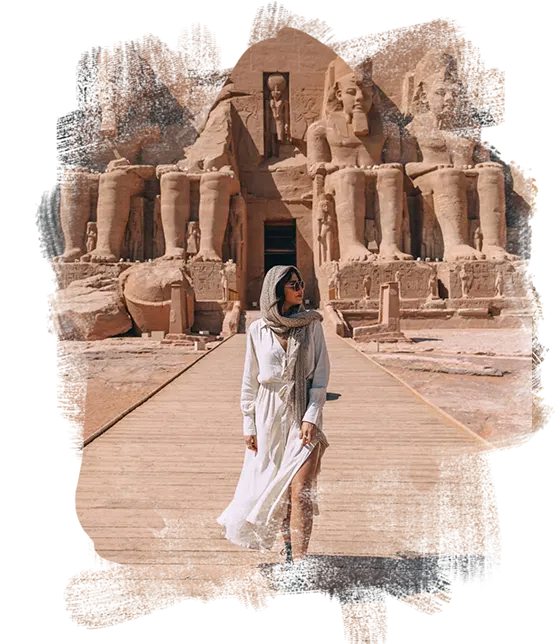
Nefertari's tomb is the largest and most elaborately decorated in the Valley of the Queens, a scale usually reserved for kings, not their wives. She was the first and most favored of Ramesses II's Great Royal Wives, married to him before he took the throne around 1279 BC, and appears more often in his monuments than any other royal woman. He built her a temple of her own at Abu Simbel and named her in his poetry as the one "for whom the sun shines."
Little is documented about her family origins, though her titles suggest she may have come from Theban nobility rather than royal blood. She likely died sometime in Ramesses II's twenty-fourth regnal year, based on the disappearance of her name from later records.
- Inside the Tomb: The Art That Made It Famous
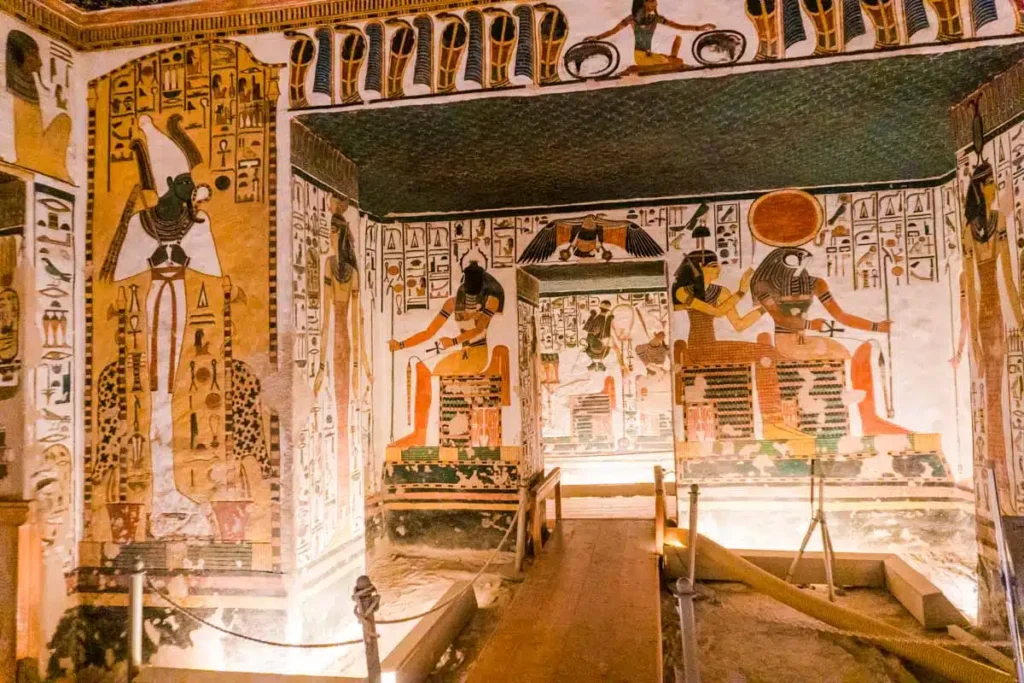
The walls of QV66 are covered in painted relief scenes from the Book of the Dead, showing Nefertari's journey through the underworld toward rebirth. She's shown being led by the goddess Isis, playing senet against an unseen opponent to secure her fate in the afterlife, and standing before Osiris and other deities who judge and welcome the dead. The colors, deep blues, golds, and reds, were painted onto a smooth plaster layer applied over the tomb's uneven limestone, which is part of why the detail has survived so cleanly.
The tomb was discovered in 1904 by Italian archaeologist Ernesto Schiaparelli, already looted in antiquity, the granite sarcophagus was found in fragments, and only parts of the queen's mummified legs remained. The paintings are the reason the tomb still draws attention today: a more complete and better-preserved cycle of funerary art than almost any other tomb from the period, which is why conservationists have handled it so cautiously since restoration work began in the 1980s.
- Why Access Has Been Restricted
The Tomb of Nefertari isn't closed by accident; it's a direct trade-off between letting people see it and keeping the paintings from deteriorating. Restoration work led by the Getty Conservation Institute and Egypt's Supreme Council of Antiquities ran from 1986 to 1992, stabilizing plaster that was flaking away from the limestone walls. When the tomb reopened to the public afterward, visitor numbers were capped and viewing time limited to protect what had just been repaired.
The core problem is humidity: every visitor's breath adds moisture to a sealed underground space, and that moisture is exactly what causes plaster to separate from stone. Over the past decade and a half, Egyptian antiquities officials have opened and closed the tomb to the public more than once in response to this, each time citing the same concern, protecting the paintings from further humidity damage.
This is also why the tomb has never been treated like a standard ticketed site. Even in periods when it's open, entry requires a separate, higher-priced ticket on top of the general Valley of the Queens admission, visits are capped at a strict 10 to 15 minutes, and photography is banned inside.
- Current Access Status (Check Before You Go)
Reports on whether the Tomb of Nefertari is open to visitors currently conflict with each other: some tour operators list active tickets for it, while recent traveler accounts from Luxor describe it as closed for conservation. This isn't unusual for QV66; its access has changed multiple times over the past fifteen years, sometimes with little public notice ahead of the change.
Because of this, don't treat any fixed claim about ticket prices or opening status, including anything written here, as guaranteed months or years from now. Before booking transport or tickets around a visit to this specific tomb, confirm its current status directly with a local operator or guide in Luxor, who will have same-week accuracy no article can promise. The general Valley of the Queens itself remains open regardless, with several other tombs accessible on the standard entrance ticket.
- Other Tombs Worth Visiting in the Valley of the Queens
The standard Valley of the Queens ticket includes access to three other decorated tombs, all consistently open regardless of QV66's status: Amunherkhepshef, a son of Ramesses III, buried in a tomb with vivid, well-preserved scenes of the young prince being introduced to the gods by his father; Khaemwaset, another of Ramesses III's sons, with a similarly compact but richly painted burial chamber; and Titi, believed to be a queen from the same dynasty, whose tomb includes scenes of protective deities and offering rituals.
None of these matches the scale or fame of Nefertari's tomb, but all three share the same painting style and mythological themes as QV66 — the same underworld journey, the same deities, the same New Kingdom artistic conventions, just on a smaller scale. For a visitor who can't get into Nefertari's tomb, they're looking at the same funerary art tradition that made it famous.
- Planning Your Luxor West Bank Day
The Valley of the Queens sits close to the Valley of the Kings, Hatshepsut's Temple, and the Colossi of Memnon, all on Luxor's West Bank, so most visitors cover them together in a single day. Crossing from the East Bank by taxi or ferry in the early morning, before the midday heat, gives enough time to see the main sites over three to four hours.
Because access to specific tombs like Nefertari's can change without much notice, a guide who checks daily conditions on the ground removes the guesswork about what's actually open. Aten Tours' Luxor Attractions itinerary covers the Valley of the Queens alongside the West Bank's other major sites, with entry arrangements confirmed in advance based on current access