White Chapel of Senusret I at the Karnak Temple complex

The White Chapel of Senusret I: Karnak's Oldest Standing Monument

Inside the Open-Air Museum at Karnak Temple stands a small limestone kiosk nearly 4,000 years old and the White Chapel of Senusret I, the oldest stand...

Ancient White Chapel of Senusret I at Karnak, Luxor

The White Chapel of Senusret I: Karnak's Oldest Standing Monument

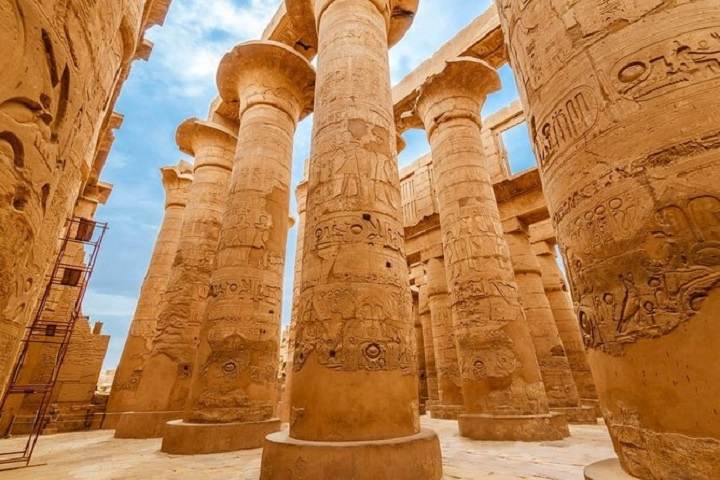
Ancient Egyptian hieroglyphs on the White Chapel at Karnak

A Small Chapel With an Outsized Reputation
The White Chapel sits inside the Open-Air Museum, a dedicated section of the Karnak Temple Complex where reconstructed monuments from various periods are displayed. Unlike the towering pylons and hypostyle hall that dominate Karnak, the White Chapel is modest in scale, a nearly square limestone kiosk raised on a platform, ringed by sixteen pillars. What it lacks in size, it makes up for in the precision of its carving, widely regarded as among the finest relief work to survive from ancient Egypt.

Built for a Pharaoh's Jubilee
The chapel was commissioned by Senusret I, the second king of Egypt's 12th Dynasty, who ruled during the Middle Kingdom around 1971–1926 BCE. It was built to mark his Sed festival, a jubilee traditionally celebrated after roughly 30 years on the throne to renew and reaffirm a pharaoh's power. The structure likely served as a ceremonial kiosk where Senusret I sat enthroned during the festival, and it may later have functioned as a barque shrine, housing the sacred bark of the god Amun during processions.

Reliefs of Exceptional Quality
The chapel's sixteen pillars carry raised reliefs depicting Senusret I being crowned and embraced by the gods Amun, Horus, Min, and Ptah. Scholars single out the carving as unusually fine even by Karnak's standards, with individual feathers and hieroglyphic details rendered with remarkable precision. Along the base of the outer walls, a separate series of reliefs records the nomes, or provinces, of ancient Egypt, along with their emblems and measurements, Upper Egypt's nomes on one side, and Lower Egypt's on the other.

Dismantled and Buried in a Pylon
About six centuries after it was built, the White Chapel was dismantled during the reign of Amenhotep III, sometime between roughly 1390 and 1352 BCE. Its carved limestone blocks were reused as filler inside the Third Pylon, a monumental gateway Amenhotep III was constructing elsewhere in the Karnak complex, a common practice among New Kingdom builders working with earlier monuments.

Rediscovered Block by Block
The chapel's blocks stayed hidden inside the Third Pylon for more than 3,000 years. French archaeologist Henri Chevrier, who directed excavations at Karnak for much of the early 20th century, uncovered them between 1927 and 1930 while clearing the pylon's interior. Because the blocks were so distinctively carved, Chevrier and later researchers were able to identify nearly all of them and reassemble the chapel close to its original form, a reconstruction largely completed by the 1940s.

The Oldest Standing Building at Karnak
Today, the White Chapel holds a unique distinction: it's considered the oldest standing structure in the entire Karnak complex, predating the New Kingdom temples, pylons, and halls that most visitors associate with the site. Its survival, thanks entirely to its second life as building material, offers a rare, close-up look at Middle Kingdom art at a site otherwise dominated by later periods.

Seeing the White Chapel at Karnak
The White Chapel is easy to miss for visitors who head straight for the Hypostyle Hall and the main temple axis, but it rewards anyone who takes the short detour into the Open-Air Museum. Aten Tours' private day tour from Aswan to Luxor includes time at Karnak Temple alongside the Valley of the Kings and Hatshepsut Temple, with a private guide who can point out details like the White Chapel that are easy to walk past on a rushed visit.
Why Choose Aten Tours

Travel with confidence with Aten Tours, where local expertise meets exceptional service. From carefully curated itineraries and handpicked experiences to seamless planning and dedicated support, we create personalized journeys designed around what matters most—comfort, quality, and unforgettable experiences across Egypt and beyond.

Secure Online Payment

Enjoy safe and secure online payments with full protection of your personal and financial information. Book your trips with confidence anytime, anywhere.

Help & Support

Travel with confidence knowing that our Help & Support team is always here for you. From booking to your return, we’re just one message away.

Tailored Travel Experiences

Your journey, your way. We design tailored experiences that match your style, ensuring comfort, flexibility, and unforgettable moments in every destination.

Client Testimonials

At Aten Tours, we are proud to create experiences that leave lasting memories. Read genuine feedback from travelers who explored Egypt’s wonders, enjoyed luxury holidays, and discovered the world with confidence and ease.

Traveling solo in Egypt with Aten Tour was one of the best decisions I made. As a 22-year-old female traveler, I was a little nervous before arriving, but I felt safe and well looked after from day one. Everything was well organized, my guide was knowledgeable, kind, and always happy to help, and I never had to worry about a thing. The whole trip was smooth, enjoyable, and filled with unforgettable moments. I'm so glad I chose Aten Tour and would definitely travel with them again.

Sarah
Sarah May 2026

My fiancé and I booked a private 5-day tour of Egypt with Aten Tours, covering Cairo, Aswan, Abu Simbel, and Luxor. From the moment we arrived, everything was perfectly organized. The team took care of every detail, making our trip completely stress-free. Our guides were knowledgeable, friendly, and passionate about Egypt's history, and every destination exceeded our expectations. Even after returning home, we still find ourselves talking about this unforgettable experience. We highly recommend Aten Tours to anyone looking for a well-planned and memorable trip to Egypt.

Thomas
Thomas May 2026

Traveling with Aten Tour made our vacation completely stress-free. Every hotel, transfer, and excursion was exactly as promised, and the team was always available whenever we had a question. We really appreciated the personal attention and warm hospitality throughout the trip. We came home with unforgettable memories and would definitely recommend Aten Tour to anyone planning a trip to Egypt.

Olivia
Olivia April 2026

We booked an 8-day trip with Aten Tour, and it turned out to be one of our favorite vacations. Everything was well organized from start to finish, which made traveling around Egypt really easy. We never felt rushed, the hotels were great, and the team was always helpful whenever we needed anything. Egypt had been on our bucket list for a long time, and we're so glad we chose Aten Tour for this experience.

Nicholas
Nicholas July 2026

Our family booked a tour with Aten Tour after reading several positive reviews, and they definitely lived up to our expectations. Communication before the trip was quick and helpful, and everything during the tour was exactly as described. The hotels were comfortable, the transportation was smooth, and the guides made every stop interesting with their stories and local knowledge. Egypt had always been a dream destination for us, and this trip made it even more memorable.

Emma
Emma June 2026

All FAQ about Egypt

The pillars depict Senusret I being crowned and embraced by the gods Amun, Horus, Min, and Ptah. The base of the chapel carries a separate series of reliefs listing the nomes, or provinces, of ancient Egypt with their emblems and measurements.

French archaeologist Henri Chevrier found the chapel's carved blocks inside the Third Pylon between 1927 and 1930 while excavating at Karnak. Because the blocks were so distinctively decorated, researchers were able to identify and reassemble nearly the entire structure.

About six centuries later, Pharaoh Amenhotep III had the chapel dismantled and its blocks reused as filler inside the Third Pylon, a new gateway he was building elsewhere at Karnak, sometime between roughly 1390 and 1352 BCE.

The name refers to its fine, pale limestone construction, which set it apart visually from the sandstone used in most other Karnak monuments. It's also sometimes called the Jubilee Chapel of Senusret I.

The White Chapel is a small limestone kiosk built by Pharaoh Senusret I around 1971–1926 BCE to mark his Sed festival jubilee. It stands today in the Open-Air Museum at Karnak Temple and is considered the oldest surviving structure in the entire complex.

94%
WhatsApp Call