Temple of Amada: Nubia's Oldest Surviving Temple on Lake Nasser
What Is the Temple of Amada and Why It Matters
Amada is the oldest standing temple in Nubia, built on the west bank of what's now Lake Nasser, about 180 kilometers south of Aswan. Pharaoh Thutmose III started construction around 1450 BC, during Egypt's 18th Dynasty. His son Amenhotep II and grandson Thutmose IV both added to it — three generations of the same family, building on the same site.
It was dedicated to Amun-Ra and Ra-Horakhty, a pairing that shows up in temples built to project Egyptian religious authority into conquered territory. Nubia was a frontier province at the time, and Amada worked as both a religious outpost and a statement: Egypt was here to stay.
The temple itself is small next to Karnak or Abu Simbel. What sets it apart is condition. Some of the best-preserved painted reliefs from the New Kingdom anywhere in Nubia are on these walls, with blues, reds, and golds that still look close to original. That's rare for a site this old. The reason comes down to plaster, and it's worth explaining properly further down.
History and Construction: Three Pharaohs, One Temple
Thutmose III built the sanctuary and inner rooms first. Amenhotep II extended the decoration and left his own record on the sanctuary's back wall — a military campaign in Syria-Palestine. Thutmose IV added the hypostyle hall, the columned entrance hall, in front of what was already there.
Later kings kept adding to it. A stele near the entrance, from the reign of Merenptah, describes a failed Libyan invasion of Egypt around 1209 BC. Odd thing to find carved into a Nubian temple wall, but that was the point — these buildings doubled as public records of a pharaoh's military standing, not just places of worship.
The Akhenaten Erasure and Later Restoration
During the Amarna Period, Akhenaten ordered Amun's name and image chiseled out of temples across Egypt. Amada wasn't spared. Workers removed Amun's name everywhere it appeared on the walls.
It didn't stay that way. After Akhenaten died, Seti I had the erasures restored. Egyptologists actually use this kind of damage-and-repair pattern to help date temple inscriptions — the gap between the original carving, the erasure, and the restoration leaves a rough timeline in the stone itself.
Why the Painted Reliefs Are So Well Preserved
This is the part that makes Amada different from most other Nubian temples. In the 6th century AD, early Christians converted it into a church, and to do that, they plastered over the older reliefs — scenes of pharaohs making offerings to Amun-Ra and Ra-Horakhty.
That plaster stayed up for over a thousand years. When it was eventually removed, the paint underneath had been shielded from sun, sand, and centuries of handling. What's left is some of the strongest color saturation you'll find in any Nubian temple. The irony is hard to miss: religious vandalism ended up being the thing that saved the art.
How the Temple Was Saved From Lake Nasser
In the 1960s, Egypt started building the Aswan High Dam, which meant flooding a long stretch of the Nile valley to create Lake Nasser — including Amada's original site. UNESCO led an international rescue campaign to save the Nubian monuments before the floodwaters reached them, and Amada's case turned out to be trickier than most.
At Abu Simbel, engineers cut the temples into blocks and rebuilt them higher up. That approach would have torn apart Amada's painted interior. So French engineers moved the whole building intact instead — hydraulic lifts to raise it, rails to slide it roughly 2.5 kilometers to higher ground. It's one of the few times an entire ancient structure was relocated as one piece rather than taken apart first.
How to Visit the Temple of Amada Today
Amada is remote, and there's no regular public transport out there.Most travelers experience it as a single stop on a multi-day Lake Nasser cruise, usually paired with the nearby Temple of Derr and the Tomb of Pennut, both relocated in that same UNESCO effort.
Independent visits are technically possible with private transport and advance permits, but the distance from Aswan and the lack of infrastructure around New Amada village make that impractical for most travelers. If you're already booked on an Abu Simbel or Lake Nasser cruise itinerary, Amada is usually included — worth checking with your specific cruise operator, since exact stops and schedules vary by company and season.
Temple of Amada vs. Abu Simbel: What's the Difference
Both were saved from Lake Nasser in the same UNESCO campaign. That's about where the similarities end.
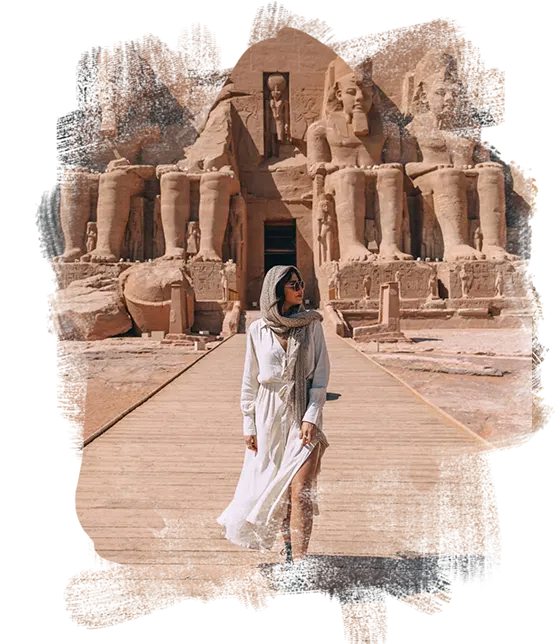
Abu Simbel is the big one — four seated colossi of Ramesses II, cut apart and rebuilt at a new site, easy to reach by road or a short flight from Aswan. Amada is smaller, centuries older, and dedicated to different gods (Amun-Ra and Ra-Horakhty, not a deified Ramesses II). Getting there means a boat, and that alone keeps the crowds away.
Want scale and crowds? Abu Simbel. Want to stand in front of 3,400-year-old paint that still looks wet, with almost nobody else around? That's Amada.