The Step Pyramid of Djoser: Egypt's First Pyramid at Saqqara
What Is the Step Pyramid of Djoser?
The Step Pyramid of Djoser is a funerary monument at Saqqara, the royal necropolis of Memphis, ancient Egypt's Old Kingdom capital. Built around 2670 BC during the Third Dynasty, it served as the tomb of Pharaoh Djoser and is recognized as Egypt's oldest pyramid and the world's earliest large-scale stone building.
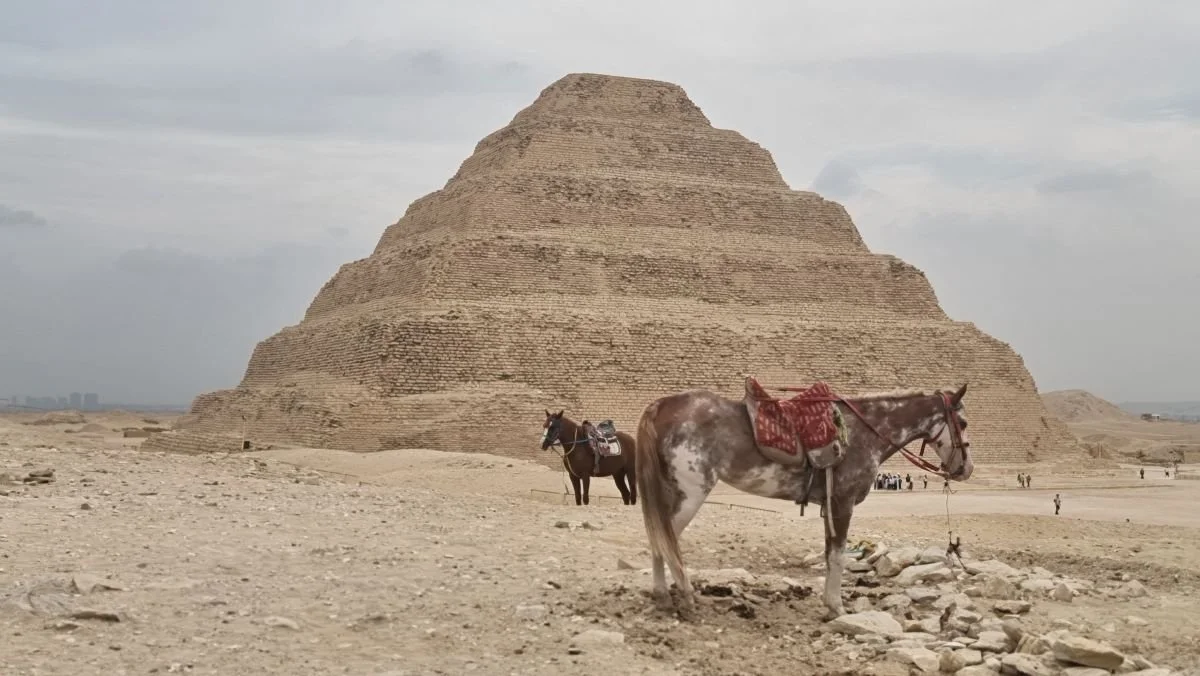
Rather than the smooth, triangular shape associated with the pyramids at Giza, the Step Pyramid rises in six distinct tiers, reaching a height of roughly 62 meters (about 203 feet). Its architect, Imhotep, created this stepped form by stacking a series of progressively smaller mastabas—the flat-roofed rectangular tombs used for Egyptian burials before Djoser's reign—one on top of another. This was a deliberate architectural experiment: earlier Egyptian royal tombs were single mastabas built from mudbrick, so building an entire structure from cut limestone, in stacked stages, had no precedent anywhere in the world at the time.
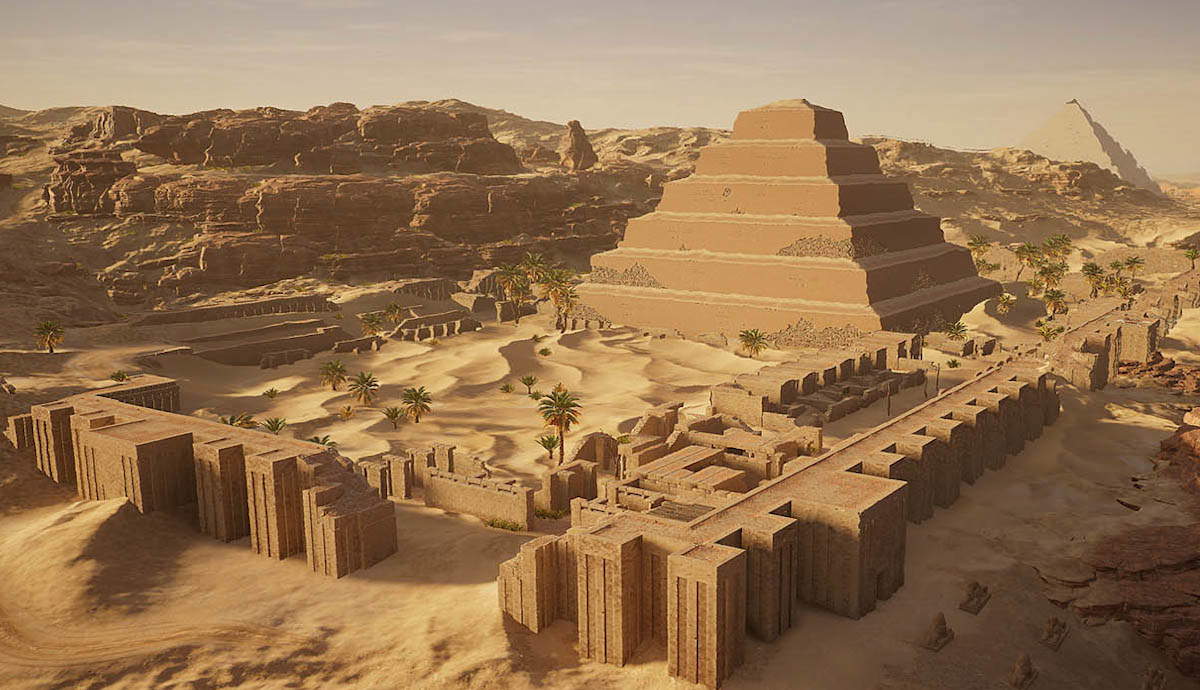
The pyramid sits at the center of a much larger walled complex, which includes courtyards, dummy shrine buildings, and a network of underground galleries and chambers beneath the pyramid itself. This complex, not just the pyramid, is what most of a Saqqara visit actually covers.
Djoser and Imhotep — The King and the Architect Behind It
Djoser was a king of Egypt's Third Dynasty, ruling around 2670 BC at the start of what Egyptologists call the Old Kingdom. His reign marks a turning point: the shift from Egypt's early dynastic period, when royal tombs were built from mudbrick, to the age of monumental stone construction that would eventually produce Giza.
The pyramid itself is credited to Imhotep, Djoser's chief architect and vizier — the earliest architect in history known by name. Beyond architecture, Imhotep also held roles as a high priest and, according to later Egyptian tradition, a physician. Centuries after his death, he was deified and worshipped as a god of medicine and wisdom, a distinction given to very few non-royal Egyptians. Archaeologists identified his role in the project from an inscription within the pyramid complex that credits him by name and title.
What Imhotep built for Djoser wasn't just a bigger tomb. It was a working solution to problems no one had faced before: how to quarry, transport, and stack enormous stone blocks with copper tools and how to keep a six-tier structure structurally stable as its design changed mid-construction. Archaeological evidence shows the pyramid went through several building phases, expanding outward and upward from an initial single mastaba into the stepped form seen today.
Inside the Complex — What You'll See on a Visit
The Colonnaded Entrance
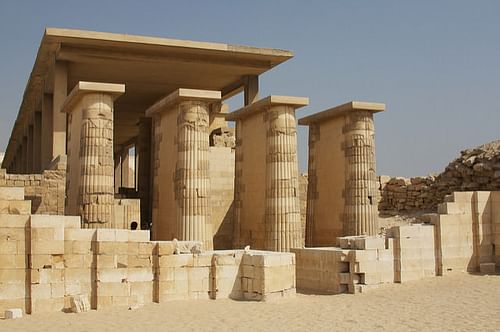
Visitors enter the Step Pyramid complex through a long, roofed corridor lined with 40 engaged limestone columns, each carved to resemble bundled papyrus reeds. The columns were cut from stone but shaped to imitate the plant-bundle construction techniques used in earlier mud brick and reed buildings—one of the earliest known examples of architecture translating an older building material into a permanent one. The corridor leads into the Great South Court, the open space that fronts the pyramid itself.
The Great South Court and Heb-Sed Courtyard
The Great South Court is a large open area used to stage the Heb-Sed festival, a royal jubilee ceremony traditionally held after 30 years of a king's reign to ceremonially renew his strength and right to rule. Surrounding the court are rows of dummy chapels — solid stone facades with no interior rooms, built purely to represent, in permanent form, the temporary shrines that would have been used during a real Heb-Sed ceremony. Whether Djoser himself ever lived long enough to celebrate an actual Heb-Sed is uncertain; the court's design suggests it was built so he could perform the ceremony symbolically for eternity regardless.
The Pyramid and the Burial Shaft
Beneath the pyramid, a vertical shaft descends roughly 28 meters into the bedrock to Djoser's burial chamber, which still holds his granite sarcophagus. A network of tunnels and storage galleries — reportedly extending several kilometers in total — surrounds the burial chamber, connecting to store rooms that once held funerary goods. Some of these underground spaces were lined with blue faience tiles, a decorative detail believed to echo the reed-mat wall coverings of a royal palace. Access to the burial shaft depends on the site's current restoration schedule; it is open to visitors at some times and closed at others, so it's worth checking before planning around it.
Step Pyramid of Djoser vs. the Pyramids of Giza
Both sites were built as royal tombs during Egypt's Old Kingdom, but they represent different stages of the same architectural idea, roughly a century apart.
Built: The Step Pyramid of Djoser was built around 2670 BC, during Egypt's Third Dynasty, making it the earlier of the two monuments. The Great Pyramid at Giza followed about a century later, around 2560 BC, during the Fourth Dynasty, after pyramid-building techniques had advanced significantly.
Shape: Djoser's pyramid rises in six distinct steps, a shape that came from stacking progressively smaller mastaba tombs on top of one another. The Great Pyramid at Giza has smooth, sloped sides instead—the "true pyramid" form most people picture when they think of ancient Egypt and the design that later pyramids followed.
Material and construction: The Step Pyramid was built from small, hand-cut limestone blocks, reflecting the still-developing stoneworking techniques of Djoser's era. The Great Pyramid used far larger limestone blocks for its core, with granite reserved for internal chambers, showing how much engineering knowledge had advanced in the century between the two projects.
Built for and designed by: The Step Pyramid was built as the tomb of Pharaoh Djoser and designed by his architect, Imhotep, who is the earliest architect known by name in all of history. The Great Pyramid was built for Pharaoh Khufu; its architect isn't confirmed with certainty, though it's traditionally linked to Khufu's vizier, Hemiunu.
Surrounding complex: Djoser's pyramid sits inside a walled complex of courtyards, dummy shrine buildings, and underground galleries built specifically for his symbolic afterlife rituals. Giza's complex is laid out differently, with a causeway, a valley temple, smaller pyramids for royal queens, and the Great Sphinx guarding the site.
Visitor experience today: Saqqara draws far fewer visitors than Giza, which makes it easier to explore the complex at an unhurried pace and, when conditions allow, to access the underground burial shaft. Giza offers greater monumental scale and the more widely recognized skyline view but comes with significantly larger crowds, especially in the morning.
The core difference between the two sites is architectural evolution, not competition. Djoser's monument was Egypt's first attempt at building permanently in stone, and its stepped shape came from a construction method—stacking mastabas—rather than a finished design vision. By the time Khufu's architects planned Giza roughly a century later, that method had been refined into the smooth-sided, true pyramid shape that defines Egypt in most people's minds. Saqqara shows the thinking behind the pyramids; Giza shows the finished result.
For travelers who've already seen Giza, Saqqara offers a different kind of visit: smaller crowds, more room to explore at pace, and a clearer sense of how the monument was actually built.
Visiting Today — Tickets, Hours, and Practical Tips
The Step Pyramid is part of the wider Saqqara archaeological site, and a single general admission ticket covers entry to the complex, including the pyramid itself, the surrounding courtyards, and the Imhotep Museum near the main entrance. As of recent visitor reports, the general Saqqara ticket costs approximately 600 EGP (around $12 USD) for foreign visitors, while a small number of individual tombs within the wider necropolis, such as the Tomb of Ti, require a separate ticket purchased on-site.
The site generally opens around 8 a.m. and closes in the late afternoon, in line with standard hours for Egypt's major archaeological sites. Arriving early is worth it beyond the temperature: tour buses tend to arrive from mid-morning onward, so the first hour or two after opening is noticeably quieter.
A few practical points worth knowing before visiting:
Payment: Most official ticket counters in Egypt now accept card payment only; carrying some cash as backup is still sensible for smaller vendors nearby.
Photography: Photography is generally allowed across the Saqqara site, though flash and tripod use inside underground chambers may be restricted.
Sun and terrain: The site is largely open desert with limited shade. Comfortable walking shoes, sun protection, and water are worth bringing regardless of season.
Interior access: Descending into the burial shaft depends on the site's current restoration schedule and isn't guaranteed on any given day.
Guides: Saqqara's on-site information boards are limited compared to Giza, so a knowledgeable guide adds more value here than at more heavily signposted sites.
Best Time to Visit and How Long to Allow
The most comfortable months to visit the Step Pyramid are between October and April, when daytime temperatures at Saqqara stay in a manageable range for walking around an exposed desert site. Visiting between June and August is possible but demands earlier starts and more sun protection, since afternoon heat on the open plateau can be intense with almost no shade.
Within a single day, the early morning slot—shortly after opening—tends to offer the quietest experience, before tour groups from Cairo hotels start arriving. Late afternoon, closer to closing time, is the second-best window, though some interior areas may already be winding down.
How much time to set aside depends on what else is on the itinerary. Seeing the Step Pyramid complex on its own—the colonnaded entrance, the Great South Court, and the pyramid itself—realistically takes about one to one and a half hours. Visitors who want to also see the Imhotep Museum, the Pyramid of Unas with its inscribed Pyramid Texts, or one of the decorated mastaba tombs nearby should plan for three to four hours at the wider Saqqara site. Those combining Saqqara with Memphis and the pyramids of Dahshur in a single day typically need six to eight hours in total, including travel time between sites.
Getting There from Cairo
Saqqara sits roughly 30 kilometers south of central Cairo, on the west bank of the Nile near the site of ancient Memphis—closer to the city center than Giza, which sits slightly further out on Cairo's western edge. There's no public transport route that goes directly to the site, so most visitors reach it by private car, taxi, or organized tour rather than public buses or the metro. The drive typically takes 45 minutes to an hour, depending on Cairo traffic and the starting point within the city.
The most common way to visit is as part of a single day that also includes Giza and Memphis, since all three sites sit relatively close together on Cairo's western outskirts. Traveling this way in one loop, rather than as three separate trips on different days, cuts down significantly on total driving time and lets visitors follow the arc of pyramid development in the order it actually happened — from Djoser's stepped design at Saqqara, through the ancient capital at Memphis, to the finished pyramid form at Giza.
Independent travelers who prefer to focus on Saqqara alone can also arrange a taxi or ride-hailing car for a half-day trip rather than a full-site loop. Since the area around Saqqara has limited transport infrastructure compared to central Cairo, it's worth agreeing on wait time and the return journey with the driver in advance, rather than expecting to find another ride on-site once you're ready to leave.
Seeing the Step Pyramid as Part of a Wider Saqqara Visit
For most travelers, the Step Pyramid works best not as a stand-alone stop but as part of a longer day that also takes in Memphis and Giza, tracing the full evolution of pyramid-building in a single trip rather than three separate ones. Seen together, the three sites tell one continuous story: Saqqara shows where the idea of a monumental stone tomb began, Memphis shows the capital it was built to serve, and Giza shows where the design ultimately arrived.
For travelers with limited time in Cairo, the Step Pyramid is worth prioritizing over the smaller mastaba tombs nearby, since it's the monument that shows the design thinking — the shift from mudbrick to stone, the stacked mastaba structure — behind everything else at Saqqara. The individual tombs add detail to that story, but the Step Pyramid is where the story itself begins.