The History of Ancient Egypt Under Roman Rule

From Pharaohs to Provinces
In 30 BCE, Egypt stopped being ruled by pharaohs and became the personal property of a single Roman emperor. That emperor was Octavian, soon to be known as Augustus, and his takeover ended nearly three thousand years of native and Greek-speaking rule. Unlike other Roman territories, Egypt wasn't handed to the Senate to govern. Augustus kept it under his own control, run by a prefect he appointed himself, because the grain grown along the Nile was too valuable to risk on politics back in Rome.
Cleopatra, Actium, and the End of an Era
The woman who lost Egypt to Rome wasn't a passive bystander. Cleopatra VII, the last ruler of the Ptolemaic dynasty, had already outmaneuvered rivals and allied herself first with Julius Caesar, then with Mark Antony, to keep her kingdom independent. That strategy collapsed at the Battle of Actium in 31 BCE, when Octavian's fleet defeated the combined forces of Antony and Cleopatra off the coast of Greece. Both died within a year, ending a dynasty that had ruled Egypt since Ptolemy, a general of Alexander the Great, took the throne three centuries earlier.
Temples Rome Built and Kept
Roman emperors, whatever their politics back home, understood something important: Egyptians expected their rulers to build temples in the old style, with the old gods, carved in the old way. So they did. At Dendera, reliefs still show Cleopatra and her son Caesarion in traditional pharaonic dress on a temple wall built partly under Roman rule. At Kom Ombo, a temple dedicated to the crocodile god Sobek and the falcon god Horus received Roman-era additions. On the island of Philae, Roman emperors added their own structures onto a temple complex the Ptolemies had already been building for the goddess Isis.
Trajan's Kiosk at Philae
The best-known Roman addition at Philae is a roofless colonnaded structure known as Trajan's Kiosk, built in the early second century CE. It was never finished, but its fourteen columns still stand beside the Nile near Aswan, and it remains one of the most photographed Roman-era structures in Egypt.
A Blended Faith
The relationship between Egypt and Rome didn't flow in just one direction. Egyptian religion traveled to Rome too, particularly the cult of Isis, which spread across the Mediterranean and gained temples in Pompeii and even in Rome itself. Isis was often merged with the god Serapis, an invented deity blending Egyptian and Greek traits, giving Roman citizens a version of Egyptian religion they could adopt without abandoning their own gods entirely.
The Fayum Portraits
Perhaps the most human record of this period comes from the Fayum oasis, southwest of modern Cairo. There, mummies from the Roman period were sometimes fitted with painted wooden portraits of the deceased, done in a naturalistic Greco-Roman style completely unlike traditional Egyptian funerary art. These faces, painted in wax-based pigment nearly two thousand years ago, look startlingly modern, and many survive today in museums including the Egyptian Museum in Cairo, the British Museum, and the Metropolitan Museum of Art.
Grain, Taxes, and Everyday Life
Rome didn't take Egypt for sentimental reasons. Egypt's harvests fed a large share of the city of Rome, and its administrators tracked that wealth obsessively, recording taxes, land ownership, and grain shipments on papyrus documents, thousands of which survive. A prefect governed in the emperor's name, Roman soldiers were stationed along the Nile, and Alexandria functioned as the administrative and commercial hub connecting Egypt's resources to the rest of the empire.
The Long Fade
Roman rule over Egypt didn't end suddenly. Christianity spread through the country in the first centuries CE, and by the fourth century it was Rome's official religion, slowly pushing the old temple cults toward extinction. The final blow came in the sixth century CE, when Emperor Justinian ordered the temple at Philae, the last active center of ancient Egyptian religious worship, permanently closed. It marked the quiet end of a religious tradition that had lasted longer than almost any other in human history.
Seeing This History Today
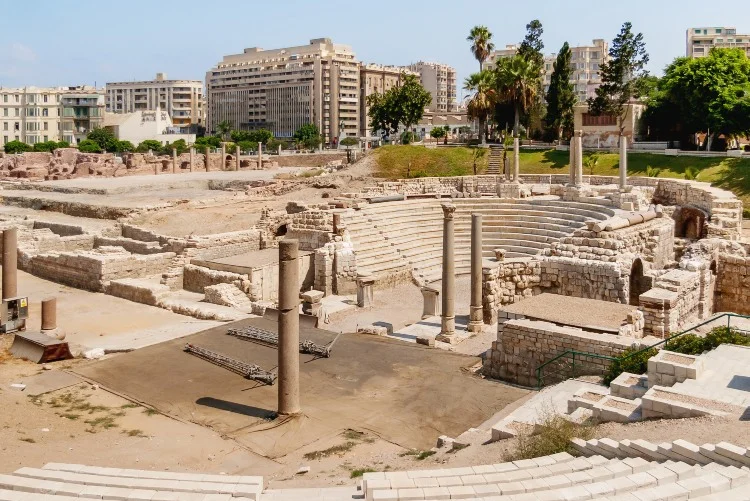
Travelers can still walk through this chapter of Egypt's past. Dendera, Kom Ombo, and Philae remain accessible from Aswan and Luxor, while Alexandria's Greek and Roman heritage offers a more concentrated look at the era, with catacombs, an amphitheater, and museum collections within a single city. Many visitors combine both by pairing a Nile itinerary with a day trip from Cairo to Alexandria, first checking how to get from Cairo to Alexandria as part of a longer route through Egypt's Greco-Roman past. Guided tours make it easier to connect sites built centuries apart, since a knowledgeable guide can point out details, like the Roman-era reliefs at Dendera, that a self-guided visit might miss entirely.